Saturday, July 9, 2011

Naamah's Blessing - Jacqueline Carey

Naamah's Blessing is the third book in Carey's Moirin trilogy and the ninth in the Kushiel's Legacy series. Carey has indicated that it will be the last book in the series, at least for the moment, and that she intends to write an unrelated series after this, which will be more of an urban fantasy. She also has a second book coming out later this year. Saints Astray is the much anticipated sequel to Santa Olivia, one of my favourite books of 2009, and is scheduled for a November release. I very much look forward to reading that one. As for the Kushiel Series, it has had its ups and downs, personally I think it is a good idea that Carey is going to focus on something else for now. I wasn't terribly impressed with Naamah's Curse. This book is a bit better but still nowhere near the level of Kushiel's Dart, the outstanding first novel in the series.

After a long journey back form the east, Moirin and her husband Bao arrive back in Terre D'Ange. Although Moirin has followed her destiny and overcome the challenges she faced in Ch'in, she knows her adventures are not over yet. In fact, there is quite a lot of unfinished business to be taken care of. For one thing, Moirin is confronted with the daughter of the Queen, one of Moirin's many lovers who died in childbirth while Moirin was travelling. The King has not recovered from the death of his second wife well and it is turning into a full blown political crisis when the King's chancellor shows a bit more ambition than is proper for his position. There is also the matter of Raphael de Mereliot, another former lover who has developed decidedly megalomaniac tendencies. Resolving this loose end will require another long journey. One to the recently discovered New World.

Carey again takes us to a previously unexplored part of her world. We visit the Aztec and Inca empires in this novel, recently discovered by the Aragonians. It is mentioned that these new lands have been discovered in Moirin's lifetime, which is one of the most precise historical markers in the entire series. It would put this novel in the early 16th century. It also shows how much liberty Carey has taken with historical developments in over the course of the series. In Naamah's Blessing for instance, the suppresses the use of gunpowder in the Ch'in civil war, something that in our history was already pretty well established by that time in Europe. There's lot of historical details in these novels but for the sake of the story, Carey didn't attempt too much historical accuracy. Personally I would have appreciated it if some of the key elements in the series had been a bit more consistent but we have to keep in mind it is a work of fiction.

One of the works Carey used in researching this novel is Jared Diamond's Guns, Germs and Steel, which, to my shame, I have to admit I haven't read. I'm familiar with its central thesis though, that the dominance of Eurasian cultures can be explained by environmental and geographical factors rather than genetic or intellectual superiority. Of the three elements in the title, Carey has already taken care of the guns. She further levels the playing field by having Raphael offer a cure to the pox to the Nuhuatl (Aztec) Empire, much to the dislike of the Aragonians (Spanish). It inserts an interesting shade of grey into what would have other wise have been a classic evil overlord type of villain. Steel is also mention as something both the Aragonians and D'Angelines try to keep out of the hands of the Nuhuatl. She spoils the effect a little by having one of the characters behead someone in a single stroke using a maquahuitl (an wooden sword-like weapon with obsidian embedded in the blade), which strikes me as rather unlikely. Still, armour and horses are a great advantage.

In a world where the gods of many people seem to be able to influence life on earth, the way Carey deals with the human sacrifices a Aztec empire was known for is interesting. Carey has never shied away from behaviour that would be considered taboo in most cultures. This one is a bit more problematic than most though. Structural human sacrifice is rare in human history, certainly on a scale the Aztecs seemed to practice it. In a world where many of the sacrifices made to the gods are necessary, does this extend to human sacrifice as well? Early on in the novel it seems the Aragonians are attempting to stop the practice but human sacrifice is key to solving Moirin's problems. Until now, the sacrifices made by the main character in the book, no matter how horrible, where mostly personal in nature, Carey definitely enters into new territory here and not all readers will appreciate it.

Once we reach the stronghold of Raphael, my suspension of disbelief collapsed entirely in the space of a few pages. This was not actually caused by something the author did but rather a strange association my mind insisted on making. Rapheal, in Naamah's Kiss, acquired the language of ants from a demon he tricked Moirin into summoning for him. It turns out to be a curse as they don't have anything intelligent to say. When we meet Raphael again, he has turned this annoyance into a weapon and managed to find a way of controlling the ants by somehow having his body produce the right chemicals. Not this is a bit of a stretch already but it gets worse. Maybe 20 years ago I read a number of books in a series of absolutely dreadful westerns that were very popular here in the 1970s. They were written by a German author using the pen-name Conrad Kobbe and to my knowledge they have never been translated in English. Most of them were set in the American West but once in a while, the main character, a bandit hunter by the name of Conny Coll, ended up in South America as well. In one of those adventures features a voracious horde of army ants insisting on overrunning a fort of some kind. It was entertaining but also completely ridiculous. I can't remember how Coll overcame this obstacle but no doubt his aim was impeccable. Much to my amusement, Raphael does indeed order his ants to serve him as an army. Ouch!

One of the things I didn't like about Naamah's Curse is that for most of the book Moirin obediently obeys the instructions of the divine guide. This novel doesn't escape that entirely in this novel but at least the gods are a bit more cryptic. I also have to hand it to Carey, she knows how to plot a novel. In the finale of the trilogy, things fall in place very nicely indeed. Not a loose end in sight. That being said, I don't think the trilogy as a whole lives up the the promise of the first novel, which is without a doubt the strongest of the three. The gods manage to thoroughly douse the spark that made Moirin such an interesting character in Naamah's Kiss. Fans of the series will no doubt devour this book and love it. Personally, I think the plot is a bit too far-fetched even for a fantasy novel. All things considered, Carey has written better novels but it is far from her worst as well.

Book Details
Title: Naamah's Blessing
Author: Jaqueline Carey
Publisher: Grand Central Publishing
Pages: 610
Year: 2011
Language: English
Format: Hardcover
ISBN: 978-0-446-19807-3
First published: 2011

Wednesday, July 6, 2011

Consider Phlebas - Iain M. Banks

Iain M. Banks is something of an unusual author in that he both publishes science fiction, under this pen-name, and main stream fiction which appears under the name Iain Banks. In science fiction, he is probably best known for his Culture novels, a series that currently spans eight book and a bunch of short fiction. I understand that it isn't necessary to read them publication order, the second novel The Player of Games is frequently mentioned as a good place to start. Not having read any of Banks work however, I thought I'd start with the first one, Consider Phlebas (1987). The Culture novels have been written more or less in chronological order as well, for those of you who prefer that approach to reading a series.

The Culture is a galaxy-spanning, post scarcity civilization. A community where things like money, laws and poverty are part of history. Their technology is capable of providing for the trillions of inhabitants, who are now free to pursue the arts, education, sports and whatever else they desire. It may sound like a socialist's utopia but there are still people who feel threatened by it. After a hundred generations of peace, The Culture finds itself at war with the Idirans, a religious, biologically immortal race on a crusade to spread their faith. With this conflict as a backdrop, Bora Horza Gobuchul, member of a race known as Changers and agent to the Idirans, is faced with a difficult assignment. He is to retrieve an advanced Culture artificial intelligence known as a Mind, stranded on an off-limits planet. The assignment is made even more difficult by the fact that he is not the only one looking.

Banks makes in interesting choice by show us The Culture though the eyes of one of its enemies. Horza may not share the Idiran religious ideals, The Culture still makes him decidedly uneasy. Especially the extent to which it relies on artificial intelligence, some of whom are sentient and enjoy the same status (I won't say right since The Culture knows no laws) as any other citizen. He's pretty convinced the Idirans are right early on in the novel but as the story progresses and he is forced to spend more time with Culture operatives and drones, his certainty is beginning to show some cracks. I thought this was an interesting bit of character development.

Horza has one thing right though, the arrogance The Culture displays is stunning. The scale of the war Banks describes is incredible, he mentions casualty figures in the trillions, destroyed planets and spaceships litter the galaxy. The Culture is ill prepared for war and until they feel the can face the Idiran threat head-on, they retreat, destroying what they cannot defend. Everything can be rebuilt at virtually no cost after all, this scorched earth tactic makes perfect sense from a rational point of view. Their conviction that, even though they are on the defensive for all of the novel, the war will eventually be won and the casual manner in which entire planets are sacrificed in a strategic withdrawals really driven home by the scale of the destruction Banks describes. It also illustrates what Horza feels is wrong with The Culture and to what extend The Culture relies on machines to dictate their strategy.

On this point Banks makes the readers doubt again. Despite the outrageous computational capacity of the most advanced Minds in The Culture, a small group of human minds is still capable of more accurately prediction future developments. The author includes brief interludes showing us one of these people and it made me wonder how much of their strategy is actually thought up by the Minds. While these sections were very interesting and give us some insight into the workings of The Culture, I would not have minded if these sections had been a bit more integrated into the main story line.

Consider Phlebas is in essence a very fast-paced space opera. Huge spaceships and incredible constructs form the background of lots of detailed action scenes. Banks rarely takes his foot of the gas for long enough to really reflect on this universe. In that respect I had expected a little more from this novel. Then again, he's clearly not done with this setting so perhaps it is just as well he leaves something to be explored for the next volumes. I don't think this novel quite justifies the praise heaped on The Culture series as a whole, the setting may be awesome, the plot itself is rather straightforward. There's also an odd sense of disconnection between he plot and the setting. None of the characters in the book seem to influence events on a larger scale in any way, which is something I more or less expected given that the book is marketed as space opera. In fact, the whole ending of the novel is rather depressing. It's a conclusion Joe Abercrombie would approve of. It was an entertaining novel but it did give me the impression there was quite a bit of room left for improvement. For this series to live up to its reputation I expect stronger novels among the other Culture books.

Book Details
Title: Consider Phlebas
Author: Iain M. Banks
Publisher: Orbit
Pages: 471
Year: 2010
Language: English
Format: Paperback
ISBN: 978-1-85723-138-0
First published: 1987

Sunday, July 3, 2011

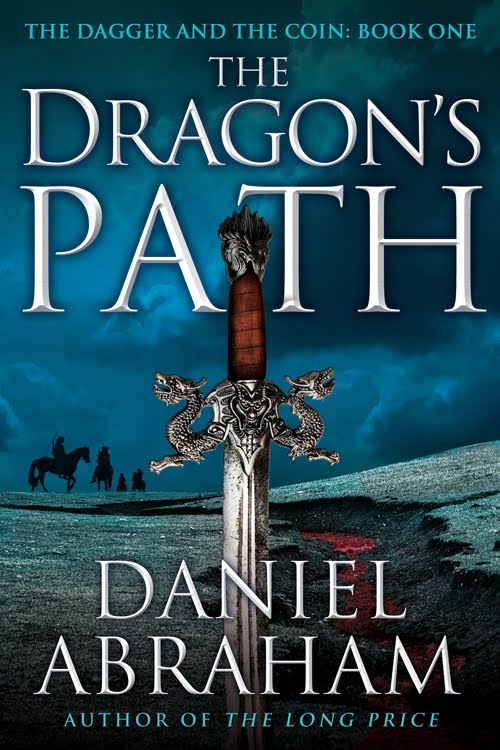
The Dragon's Path - Daniel Abraham

Since his début novel A Shadow in Summer appeared in 2006, Daniel Abraham has been writing novels at an impressive rate. 2011 will see the release of no less than three titles. April saw the release of The Dragon's Path, the first book in Abraham's new epic fantasy series The Dagger and the Coin Quintet, in June Leviathan Wakes, a space opera written in collaboration with Ty Frank under the pseudonym James S.A. Corey appeared (this one is still on the to read stack) and in scheduled for release in November is Killing Rites, the fourth book in his urban fantasy series The Black Sun's Daughter written under the pen-name M.L.N. Hanover. That's on top of the comic adaptations and the occasional short story he is working on. Very impressive indeed.

The Dragon's Path introduces us to a new fantasy setting where the thirteen races of humanity, once united under the dragon rulers, are now divided in many different kingdoms. One of the more powerful states, Antea, is about to launch a military campaign against the city state of Vanai. Although the eyes of the empire appear to be directed outside its own borders, the campaign is but one move in a much larger internal conflict. The King struggles to keep his subjects from going for each other's throats but clearly, control is slipping away from him. It turns what ought to be a limited military expedition into a spiral of violence that could well end in civil war.

I'm a big fan of Abraham's Long Price Quartet. Its unusual, oriental flavour, its almost Shakespearian drama and the attention to characterization make it some of the best fantasy written in the last decade in my opinion. It was quite well received by reviewers but apparently didn't sell well. Publisher Tor didn't bother with a mass market paperback edition of the final book, The Price of Spring, effectively sealing the fate of the series. It's quite an achievement Abraham survived this as a writer and is still publishing under his own name. These experiences may have influenced his approach to this series, The Coin and Dagger Quintet feels a lot more like traditional epic fantasy to me.

It took me a while to get into this story. Abraham is clearly building in this novel and that means the reader should have a little patience with this book. He introduces a world that is much larger than anything he attempted in the Long Price Quartet. It took quite a few pages for me to settle into that environment. Not surprisingly, quite a few things go unexplained or are not as well developed as I might have liked in this book. The thirteen races of humanity is probably the best example. He describes most of them briefly at some point in the novel but apart from the ones the main characters belong to, most of them are still only vague images in my mind. I guess an appendix would have been nice. The history of these thirteen groups is something Abraham probably will get into in later books. He leaves some interesting titbits throughout this novel though. One of the things I'd be interested in is the apparent lack of hybrids. Somewhere in the story it is suggested that not all combinations result in fertile offspring but others obviously do.

The story is told using many point of view characters, with chapters named after the character. In this, and a few other aspects of the story, Abraham is clearly influenced by George R.R. Martin's A Song of Ice and Fire novels. He picks his characters from all layers of society. From the conservative nobleman Dawson to the mysterious mercenary Marcus, the entire fabric of society is shown to us. There seem to be two overarching conflicts in the novel that concern both the coin (economics) and dagger (military aspects) of the story. Dawson in particular, is involved in a struggle to keep farmers from gaining more influence in court. He is a great believer in the idea that everybody has his or her place in society and should not under any circumstance try to get above themselves. He shows a great dislike of the employee of a large bank he meets later in the novel for instance and resents the fact that the bank is able to wield a lot of influence thanks to their fortune rather than their station. These tensions could easily lead to armed conflict later on, something Dawson is quite prepared to face to defend his values.

The second conflict is not quite as clear yet and most likely ties into the unexplored history of Abraham's world. One of its symptoms of this approaching conflict is the re-emergence of a religious movement. The character most involved in this is Geder, the son and heir of a minor Antean nobleman. His mind seems receptive to a good dose of religious fanaticism. In fact, even without it, he is capable of some pretty drastic actions. Geder is the character I'm most curious about in the next volumes of this series. Whatever his next move is, it will most likely be quite dramatic.

Abraham introduces a clear economic component to his story, something that is often lacking in other epic fantasies. This part of the story is mostly seem through the eyes of Cithrin, a young orphan raised in the care of a banking establishment in the city of Vanai. Her protector sends her off with most of the bank's fortune to keep it from falling in the hands of the Anteans. It's the beginning of a wild adventure that will see Cithrin put into practice many of the things she's been trained to do as well as learn a thing or two about the world. I think this character is one of the stronger ones in the novel. Cithrin is a curious teenager. Her story line is a bit of an emotional roller coaster. Inexperienced as she is, she doesn't deal well with setbacks and has a tendency to look for answers in alcohol. Cithrin is definitely one of the more colourful characters in this novel, it will be interesting how the author will develop this story line.

The Coin and Dagger is a series with a lot of potential. The scope of this series is beyond what Abraham did in his previous fantasy novels and will definitely appeal to the epic fantasy fan. Personally, I thought The Dragon's Path, judged on its own merits, is not as strong as previous novels It's a bit slow to get going and, although it ends at a natural point in the story, the climax of the novel didn't have the impact on me any of the Long Price novels managed to deliver. Still, Abraham has me intrigued enough to stick with this series. It would surprise me if an author of Abraham's caliber would not be able to deliver on all that this volume promises for the rest of the series. I guess I am on board for part two: The King's Blood.

Book Details
Title: The Dragon's Path
Author: Daniel Abraham
Publisher: Orbit
Pages: 555
Year: 2011
Language: English
Format: Paperback
ISBN: 978-1-84149-887-4
First published: 2011

Thursday, June 30, 2011

The Ammonite Violin and Others - Caitlín R. Kiernan

A while ago, I bought a number of books in a Subteranean Press clearance sale. Eleven books with a huge discount but I didn't know what I would be getting. As it happened, the package contained a lot of short fiction collections, mostly of authors who's work I'm not too familiar with. Until now, I've only read and reviewed one, The God Engines by John Scalzi. The Ammonite Violin and Others by Caitlín R. Kiernan is the second of this batch. I had read one a few short stories by Scalzi but Kiernan is completely new to me. The Ammonite Violin and Others turned out the be a beautifully written collection of very dark short stories.

The collection contains 20 short stories as well as an introduction by Jeff VanderMeer (which, unless you have previous experience with Kiernan's writing, I recommend you read after finishing the stories, he lost me halfway through the first time). As usually Subterranean packaging is wonderful, a very nice high quality hardcover with plenty of attention to the coverart. I like the author picture (taken by Kathryn A. Pollnac) on the back of the book in particular. It contains too many stories to review individually but there are some comments I'd like to make on a few of them and the collection in general.

Subterranean calls these stories dark fantasy but I have a hard time pinning them down. Some of them could be horror, some have post apocalyptic feel to them, some borrow heavily from Greek and Celtic mythology. Kiernan herself does not feel she is a horror writer but some of the details from her stories do show influences of Edgar Allen Poe for instance (although H.P. Lovercraft is also frequently mentioned in discussions of Kiernan's work). A Child's Guide to the Hollow Hills for instance, shares some of his obsession with death and decay. The stories also often display a sense of helplessness and inevitability. Characters being intellectually aware that they are heading for disaster but unable to help themselves.

Most of these stories are very brief pieces, the entire collection is only 230 pages long. They are snapshots of a moment or event crucial to the character but, as VanderMeer points out in the introduction, containing very little action. Kiernan presents a lot of them as riddles to the reader. She generally leaves a lot of room for the reader to interpret the story. There's no coddling the reader, you have to actively give meaning to the images she presents. It makes these tales fascinating, sometimes mysterious, and not something to be read cover to cover in one sitting.

The stories are written in a beautifully descriptive style. Long, flowing sentences and lots of imagery mark many of these stories. To give a random example:
It's not a wild place - not some bottomless, peat-stained loch hidden away between high granite cliffs, and not a secret, deep spring bubbling up crystal clear from the heart of a Welsh or Irish forest where the Unseelie host is said to hold the trees always at the dry brittle end of autumn, always on the cusp of a killing winter that will never come.
Opening sentence of Bridle
With this one sentence Kiernan conjours up an image that completely contrasts with the urban setting of the story. Kiernan goes on to create a synthesis of the classic Kelpie myth in a modern setting. The power, glamour eroticism of this mythological creature combined with a decaying corpse in an abandoned park in the city. This coupling between the mythological and horrific returns in many of these stories.

The story that gave the collection it's name is something different entirely though. The Ammonite Violin (Murder Ballad No. 4) combines two other elements that return in the stories in this collection often: fossils (an occupational hazard given her education in palaeontology) and the sea. In fact, I don't think I know of any other writer who uses the word brine as much ad Kiernan does. The main character in this stories considers himself a collector. His two collections consist of Ammonites and suffocated women and now his is looking for a way to combine his two passions. It's incredibly creepy how he discusses these collections without any sense of guilt or regret. Despite this lack of emotion in the main character, the story has a very emotionally charged ending.

The type of work Kiernan writes is not material I read a lot. Although I try to read a decent amount of short fiction, most of it is science fiction and however you choose to label Kiernan's work, science fiction most likely isn't it. I had absolutely no idea what to expect of this collection, I guess you could say it was a bit of a gamble. One that paid off handsomely. I very much enjoyed reading The Ammonite Violin and Others. I may have to check out one of Kiernan novel length works. I would be interesting to see how Kiernan's approach would work for a longer piece. I can feel that to read stack growing again.

Book Details
Title: The Ammonite Violin and Others
Author: Caitlín R. Kiernan
Publisher: Subterranean Press
Pages: 235
Year: 2010
Language: English
Format: Hardcover
ISBN: 978-1-59606-305-1
First published: 2010

Monday, June 27, 2011

Dream of Legends - Stephen Zimmer

Last month I read Crown of Vengeance, the first novel in Stephen Zimmer's epic fantasy series The Fires of Eden. Publisher Seventh Star Press was kind enough to provide me with a copy of the second volume, Dream of Legends as well. I wasn't sure how many parts there would be in this series when I wrote the review of the first book but the publisher has informed me in the mean time that there will be seven Fires of Eden books. I felt that the first volume did have a certain appeal to fans of the epic fantasy sub genre but that the execution left something to be desired. Dream of Legends better in some ways but much worse in others. Ultimately, I felt it was a seven hundred page book with only two hundred pages worth of story in it.

Dream of Legends picks up right the story where Crown of Vengeance ends. In the Five Realms the Unifier has struck a first blow against the tribes. It quickly becomes apparent that the tribes cannot hope to hold their territory against the Unifier's onslaught. The terrain is suited to the stubborn defence the tribes put up but the number of enemy soldiers is just overwhelming. They need held and hope to find it with the Midragardians. An enemy of the Unifier as of yet out of reach of his armies. In the mean time, Saxany is about the be involved in a battle that will decide the fate of the nation. The Unifier's armies are approaching the Saxans' chosen field of battle. Their strength is overwhelming but the Saxans are not going to give up without a fight. One of the largest armies ever fielded by the Saxans awaits them, prepared to defend their homeland until the last man falls. Despite he Saxan courage, their situation looks hopeless. Like the Five Realms, the Saxans will need aid to survive the coming storm.

One of the things I disliked about Crown of Vengeance is that the Saxan story line lacked a proper climax. Zimmer builds up to a big battle that doesn't materialize at the end of the book. It does in the sequel though. In fact, a large part of the second half of the novel is dedicated to it. The fact that the battle isn't joined until the second part of the novel illustrates the major weakness of this novel. Zimmer just takes too long to get to the point. The author shows us several Saxan characters getting ready for battle, thinking how they'd rather be at home drinking good ale and how many of them are likely never to go home again. Not unusual thought on the eve of a battle but even if Zimmer hadn't expressed this sentiment in the first book already, we don't need to be told several times and certainly not in the verbose style Zimmer employs.

Another issue with Crown of Vengeance was that is introduced so many point of view characters that most of them didn't get enough time to develop. In Dream of Legends a few new characters are introduced but on the whole it is much more focussed on a smaller number of characters, enabling Zimmer to add some depth to them. Interesting about his choice of point of view is that most of the characters transported from our world to Ave, receive little or no attention. It's the natives that steal the show in this volume, which again makes me wonder if we really needed nine characters carried over from our world to tell this story.

One of the few characters from our world who does get some time in the spotlight is Lee. He's developing into something of a champion for the libertarian ideal. There's a fine rant in one of his sections where he details how the state is taxing his marginally profitable Chinese restaurant too much to spend it frivolously. It's the main reason why he gets along with the rather moody forest dweller Gunther. A man who is the ideal of self-reliance, a man who just wants to be left alone (but unfortunately the world won't let him be). Both books include quotes of Ayn Rand so this isn't entirely surprising. I'm not a great fan of this line of reasoning, it's one of the reasons I can't stand Terry Goodkind's novels. Fortunately Zimmer knows better than to bludgeon his readers with it.

While Zimmer improves in some areas, most notably the tighter focus on a more limited group of characters, the novel suffers enormously from overly detailed descriptions and long and repetitive interior monologues. It simply stifles the progress of the plot to the point where large sections of the book stall completely. I'm used to reading big books and consider myself a fairly patient reader (I rarely put a book down once I start reading it) but the temptation to skim sections of this novel rather than fully read them, was just overwhelming. If anything, this novel shows that epic fantasy is about more than getting a big word count. After reading the first two books in this series I'm afraid the only possible conclusion is that this series is not for me.

Book Details
Title: Dream of Legends
Author: Stephen Zimmer
Publisher: Seventh Star Press
Pages: 723
Year: 2010
Language: English
Format: Paperback
ISBN: 978-0-983-10862-7
First published: 2010

Friday, June 24, 2011

Long Eyes and Other Stories - Jeff Carlson

Author Jeff Carlson was kind enough to provide me with a copy of his collection Long Eyes and Other Stories. It contains three previously published, short stories. They are unconnected but they do share certain thematic links. Besides more short fiction, Carlson has also written a number of novels, none of which I've read. Based on this sample of his work, he is clearly someone to keep an eye on though. Carlson delivers a number of very good, hard science fiction tales in this collection.

The collection opens with Long Eyes (2008), a story first published in the anthology Fast Forward 2, edited by Lou Anders. It's a far future science fiction story about Clara, a woman on a lonely trip exploring the universe. Her ship is programmed with advanced decision making software, often overruling its human captain. When the ship arrives at what appears to be a marginally inhabitable planet, despite the wishes of it insists on investigating. A decision with far reaching consequences for both of them.

This story reminded me a bit of some of the stories in Poul Anderson's Technic Civilization setting I've recently been reading. The planet hides a secret that is crucial for the success of Clara's involuntary mission. Carlson also works in the her struggles between Clara and the ship's computer over control of their course of action. She is striving for control, something she never had back on earth and is only allowed in a limited fashion on her journey. It's also a clash between human intuition, inspiration and cognitive leaps against the pre-programmed algorithms of the computer. As much science fiction elements as Carlson works into this story, the motivation of the main character is the key to it. I thought it was a very well executed short story.

Next up is Planet of the Sealies, a story that originally appeared in Asimov's (February 2011). It's a tale with an environmental theme, which as you may have noticed by now, is something I generally appreciate in a story. Planet of the Sealies is set on Earth, where ecological disasters appeared to have wiped out humanity as we know it. A small group of survivors, extensively modified from a tiny genetic base, are excavating the remains of 21st century consumer society in search of useful materials.

What would a future society think when they excavate one of garbage dumps in a few centuries? Surely the waste of resources mush appear appalling to people form a society used to scarcity of resources. The real twist in this story is what materials they are actually looking for. It makes sense in hindsight but I certainly didn't see it coming. Again, the freedom to make your own decisions is a theme in the story as well. The main character struggles with the tight behavioural controls imposed by a society perpetually on the brink of extinction. This part of the story takes a different turn from the other two stories in the collection. The main character Joanna is a bit more .... hmm.. obedient than the other Clara or Garcia.

Garcia is the main character of the final story in the collection. Pressure (2003) was originally published on Strange Horizons but is no longer available on that site. Garcia is an ex-Navy SEAL who has volunteered for a radical procedure to help him deal with the pressure of deep water diving. The modifications to his body allow him to go beyond the limits for normal divers. The project pays well and the modifications are said to be reversible. It does mean he'll spend two years away from his family, something his wife Andrea is less than pleased about.

The main character is a man torn between the two loves of his life, diving and Andrea. Carlson chose to write this from a first person perspective, which suits the story very well. As the story progresses, Garcia starts to feel more and more at home in his underwater environment. Another aspect of the story I liked was the way the author included an interesting environmental questions into the story. How do you weigh the generation of clean, renewable power against deep sea habitat destruction? It's a minor plot point but a very nice detail.

Long Eyes and Other Stories collect three stories that will appeal to fans of hard science fiction. Post-human characters and glimpses of far future societies are combined with a lot of attention to character and motivation. There's a dark, eerie quality to Carlson's writing that helps convey how alien the environments the stories are set in really are. I thoroughly enjoyed reading this collection. In this collection, Carlson shows that a lot of the more interesting writing in science fiction is still being done in the short format.

Book Details
Title: Long Eyes and Other Stories
Author: Jeff Carlson
Pages: 42
Year: 2011
Language: English
Format: E-book
First published: 2011

Tuesday, June 21, 2011

House of Chains - Steven Erikson

House of Chains is the fourth of ten volumes in Steven Erikson's Tales of the Malazan Book of the Fallen. Like everybody, I have my favourites in this series and two of the books I enjoyed most are Memories of Ice and Midnight Tides. House of Chains is in between these two and I consider it the weakest of the ten books. That is not to say I didn't like it, but it doesn't work quite as well as some of the others. It is a novel that sets the stage for taking the story far outside the boundaries of the Malazan Empire however. There are lots of hints and bits of information about events elsewhere in world that prepare the reader for what is to come. I missed a lot of that on my first read. It's very easy to underestimate the importance of the bits information Erikson provides in this book.

Once again, the story takes us to the Seven Cities where Adjunct Tavore Paran and her recently formed 14th Army have arrived to deal with the aftermath of the Chain of Dogs. She's an inexperienced commander, leading a green army, seriously outnumbered, short on mages and fighting on hostile terrain with supply lines stretched to the breaking point. In other words, the situation appears hopeless and Tavore doesn't even know the worst of it. Her sister Felesin, whom she allowed to be sent tot he otataral mines during Empress Laseen's latest cull of nobility, leads the Whirlwind rebellion. Now possessed by a vengeful goddess, Felesin awaits her sister's army in the Holy Desert of Raraku. Like her sister, Felesin has her problems. Her army is made up of a number of factions, each with their own agenda and often with ambitions that far exceed the Whirlwind rebellion. Such a clash of power and interests is bound to catch the attention of the gods. A convergence seems inevitable.

One of the things that is remarkable about this book is that the first part, about a quarter of the total novel, is completely taken up by the back story of one character. Karsa Orlong makes a brief appearance in Deadhouse Gates, the novel chronicling the events that lead up to this book. Karsa is Erikson's way of making fun of a fantasy cliché's, he's Conan on steroids. Especially early on, he's presented as a giant, barbarian warrior, obsessed with a quest for what he considers glory, and out to slay as many enemies as possible. When he leaves his isolated tribe and ventures into the lands of the 'children', as his tribe views ordinary humans, he has a hard confrontation with the world. Surprisingly, he learns that not all problems can be solved with violence. I absolutely love the way Karsa keeps expressing himself in the terms a Teblor 'barbarian' would use but tackles ever more sophisticated ethical and philosophical opinions with it. One such opinion leads to one of the most hilarious scenes in the novel as Karsa rides up to the Tavore, backed by a full Malazan army, and tells her of his change of heart concerning the Malazan Empire.
'Speak then,' Tavore said.
The giant bared his teeth. 'Once, long ago, I claimed the Malazans as my enemies. I was young. I took pleasure in voicing vows. The more enemies the better. So it was, once. But no longer. Malazan, you are no longer my enemy. Thus, I will not kill you.'
'We are relieved,' Tavore said drily.
Karsa Orlong and Adjuct Tavore - Chapter 26
Another aspect of Karsa's story I liked a lot was his quite literal demonstration of his opinion that man makes gods and not the other way around. As important as Karsa may be for the rest of the series, it does feel as if the first section is a huge prologue and that the novel doesn't get started until we fast-forward to the events following the Chain of Dogs. In terms of structure it was a peculiar choice of Erikson to include such a long section that is essentially set apart from the rest of the novel.

Another major player we meet in this novel is Trull Sengar. First of the four (and here I was thinking Erikson likes to do things in three) Sengar brothers, he is left chained in a destroyed part of a warren known as the Nascent. He's another character who gets surprisingly little done in this novel. Erikson is setting things up for Midnight Tides I suppose, a lot of which deals with Trull's back story. The friendship that develops between the Imass Onrack and Tiste Edur Trull is interesting to watch though. The author slips in quite a bit of history of the world into the conversations between the two and those they meet along the way. More bits and pieces of the ridiculously complex history of this world fall into place.

The finale of this novel is surprising in a way. There is a convergence of course, but the whole campaign plays out differently than one might expect. Erikson leaves a lot of cleaning up to do for Tavore, which will be dealt with in The Bonehunters. Although the final confrontation between Tavore and Felesin had to potential to be as dramatic as the finale of Memories of Ice or Deadhouse Gates it didn't have the same impact on me.

I appreciated what Erikson tried to do with this book a bit more on this second read. As with the three previous books, I picked up a lot of stuff I missed during my first pass through this part of the story. I still feel Erikson is building a bit too much in this novel. It is a bridge to the third major story line Erikson will open in Midnight Tides and events that will take place in The Bonehunters and beyond, but it doesn't stand on its own quite as well as the previous books did. That being said, it is still an amazing fantasy novel, once again underlining the enormous scope and ambition of the series. It is not my favourite but even so, it is a treat to fans of the series. And a novel that only gets better the second time around.

Book Details
Title: House of Chain
Author: Steven Erikson
Publisher: Bantam Books
Pages: 1035
Year: 2003
Language: English
Format: Mass Market Paperback
ISBN: 0-553-81313-7
First published: 2002

Saturday, June 18, 2011

Hellhole - Brian Herbert and Kevin J. Anderson

Brian Herbert and Kevin J. Anderson have been working together on a whole stack of Dune novels in the past decade. I've read most of them and while they don't quite deserve the vitriol that is often directed at them, they range from entertaining at best to completely superfluous. The last one I've read, Paul of Dune (2008), convinced me that Dune was a creative dead end for these two authors. I was mildly curious when the pair announced that they were writing a new trilogy in a universe of their own however. Not enough to actually buy the book, but when a contest on Tor.com showed up I took part, and surprisingly, won a copy. They have since started including a set conditions in their contests that means you have to be a US resident to take part. Looks like it will be the first and last book I won over there. Still, I appreciate Tor being a good sport and sending me this copy.

After a failed rebellion against the corrupt regime of the Constellation, an interstellar empire that spans dozens of worlds, general Tiber Maximilan Adolphus is exiled to the newly colonized and extremely hostile planet of Hallholme. Because of the harsh conditions of this world, it is quickly awarded a nickname: Hellhole. His rebellion may have failed, Adolphus still commands the loyalty of much of the population. Despite attempts by the ruler of the Constellation, Diadem Michella Duchenet to make sure his attempt to settle Hallholme fails, he survives the first years there. Now, more than a decade later, Adolphus is at the point where he once again has the support and resources to undertake action against the tyrant Duchenet. And this time he means to succeed.

Hellhole is without a doubt, the worst book I've read this year. Herbert and Anderson manage to paint just about every character in the book in black and white, starting from the very beginning of the novel. The prologue chronicles the final confrontation in Adolphus' rebellion and outlines the general as a noble victim of circumstances rising against the tyranny of a corrupt and decadent empire. He refuses to fire on the people used as a human shields by the empire, thereby loosing the final battle. Apparently Adolphus, a man who's had leadership trust upon him, neither foresaw nor planned for this desperate tactic of the empire. Although he keeps the moral high ground, he also fails his people miserably by allowing his revolution to collapse in a single blow. Adolphus is heroic, noble, holds to impeccable moral standards but nowhere in the novel is he actually seen to inspire the loyalty he seems to command. In short, he is a cardboard character and one of many in the novel.

I guess you could see this tale as a retelling of the American revolution. An corrupt empire is burdening its colonies with unrealistically high taxes, refuses to listen to the arguments of the colonists and is seen to use the taxes mostly to support their luxurious lifestyle and support a large and mostly superfluous military machine. To complete the moral bankruptcy of the empire it is revealed to be rather wasteful with its excess of noble born children. The rebels on the other hand, strife for self determination, a meritocracy and above all, a chance to properly develop their planets. To remove any moral ambiguity that might be left, the natives of the planet Adolphus colonizes have already been taken care of a centuries earlier. They perished in a catastrophic meteor strike.

One of the attractions of this novel was that Herbert and Anderson where striking out on their own instead of working in the Dune universe. Much to my dismay, the novel borrows quite heavily from Dune. There is the harsh environment of the planet (a feature found in several Frank Herbert novels, besides Dune it appears in The Dosadi Experiment and several books in the Destination: Void universe), a corrupt and stagnating empire run along feudal lines and lacking any outside threat and of course the one noble in the empire who has understood the meaning of that word and actually takes proper care of his people. All things considered, Herbert and Anderson seem to be reluctant to let go of a proven formula for success.

The spice in this novel is not a drug but a substance that allows interstellar transport. The mineral that can be mined in meaningful quantities on one planet in the empire can be used to mark trails through space. An interplanetary trail of breadcrumbs, safe paths where spaceships can reach enormous speeds and thus cross vast distances in practical time spans. Apparently in the Herbert and Anderson universe, planets don't move relative to each other. Not surprisingly, the planet where this stuff is mined is subject of a lot of scheming and intrigue. Herbert and Anderson also wonder what would happen if the monopoly on interstellar transport would be broken (this is not actually in Dune but one of Frank Herbert's later Dune books). At one point in the novel, I wondered if all Herbert and Anderson meant to do with this novel was mix Frank Herbert's concepts up a bit, the inclusion of an alien civilization is one of the few elements not borrowed from Dune.

Perhaps it was a bit too much to hope for a fresh start from these two writers but I certainly hadn't expected them to come up with something that's so derivative. That being said, it is not actually a boring read. Herbert and Anderson sacrifice a lot of character development and world building to flit from planet to planet and character to character in order to keep up the relentless pace of the story. We're shown the bare outlines of what is going on, usually with enough history of the character to determine whether we're dealing with a good or a bad guy but not much beyond. I really can't find many redeeming qualities in this novel. I suppose that if you are looking for mindless entertainment this novel might be palatable. For me, it was a major disappointment.

Book Details
Title: Hellhole
Author: Brian Herbert and Kevin J. Anderson
Publisher: Tor
Pages: 532
Year: 2011
Language: English
Format: Hardcover
ISBN: 978-0-7653-2269-2
First published: 2011

Wednesday, June 15, 2011

Harten Sara - Thomas Olde Heuvelt

I haven't read (or reviewed) any Dutch language works since November save a few short pieces in Pure Fantasy Magazine. It's past time I had a look at what is going on in the local genre fiction scene. Thomas Olde Heuvelt is considered one of the hottest writers in Dutch genre fiction. He's one of the few Dutch authors being published be one of the major publishers of Fantasy in the Netherlands. I've read his novel Leerling Tovenaar Vader & Zoon in 2008 and have been looking forward to the next one ever since. His previous novel could be considered either dark fantasy or horror, depending on your preference, Harten Sara is quite something different. I guess the core of it is a love story. The title is a bit tricky to translate. Harten (literally: hearts) refers to one of the suits in a deck of cards and Sara is the name of the main characters. Sara of Hearts I suppose. Doesn't work too well in English and to be honest I don't like it all that much in Dutch either. The novel however, works just fine.

Sara is a young woman living with Asperger's Syndrome. Her view on the world is radically different from ours. Like many people with Asperger's Syndrome she her social skills are underdeveloped and she shows a bit of obsessive compulsive behaviour at times. Sara tends to avoid or run away from situations that, to put it in her own words, unbalance her. Her childhood was not a particularly happy one. Her mother died at birth and her father deals with that poorly. He spends most of his time watching television and drinking beer. One day, Sara meets the young and talented illusionist Sem. It's the start of an intense and complicated love affair that will teach Sara more about her past than her father was ever willing to tell her.

Almost the entire novel is seen from Sara's point of view, a first person perspective. It's something that takes some getting used to. She has a unique perception of the world and her way of telling the story shows it. There's lots of attention to particular details, colours for instance are important to Sara but she makes lots and lots of other strange leaps and associations. Sara tells her story in a non-linear fashion, flashbacks are plentiful and certain parts of the book are a string anecdotes Sara tells us to make a certain point. Olde Heuvelt eases us into it in the earlier part of the novel but later on it gets quite complex. As a reader you need to pay attention, the author uses some fairly unorthodox methods, including a bunch of typographical tricks to have the storytelling fit the character.

Harten Sara is a story that plays out on the edge of illusion and reality. Sara sees the world in ways we cannot possibly accept as real, things that are obviously illusions to the reader are accepted as a matter of course by Sara. Her world is one where magic is not necessarily a trick, something that is reinforced by the character of Sem. As an illusionist, it's his job to try to make people believe his illusions, but at the same time he is looking for a bit of magic he has lost in his youth. Throughout the novel, Olde Heuvelt uses this to great effect in the text for all manner of literary tricks. One of the bits I like in particular, is the motif of flying as an expression of ultimate freedom and complete trust (that's what I make of it anyway).

Sara's world sounds charming in a way but for most of the novel she is deeply unhappy. The love affair between Sara and Sem is headed for disaster from the beginning. Where Sem is interested in Sara, Sara feels Beesie, Sem's alter-ego (for lack of a better word, as with many things in this novel, his true nature remains unclear) is the more interesting part of Sem's personality. It drives a wedge between then that makes both of them do some pretty drastic things. They hurt each other as only lovers can. Sometimes it crosses into the melodramatic, but quite a lot of the novel is simply emotionally extremely powerful. At one point, some ninety pages before the end of the novel, I seriously wondered if I wanted to read the rest of it. At that point they were obviously not finished hurting each other. I don't want to spoil the ending of the novel, let me just say I'm glad I finished it anyway.

Besides the love story, there's a second layer worked into the novel. Sara's father has been less than forthcoming on her past and her family. Gradually Sara uncovers some of her past. Given her limited social skills, it's not surprising that Sara sees it as a complete mystery. For the reader it is much less complicated however, especially since we get additional information though the eyes of a second point of view character. The interaction between the two is very well done, I love the tree that keeps record of Sara's life in five symbols, but in the end the mystery is not much of a mystery. I feel Olde Heuvelt made this part his story a bit more complicated than it had to be.

Harten Sara is a very intense read, aiming to evoke a wide range of emotional responses in the reader. Olde Heuvelt's unusual choice of main character and perspective opens all sorts of possibilities for some beautiful imagery, something the author exploits to fullest possible extend. It's a novel that could have a much wider appeal than just the Fantasy readers his publisher usually caters too. With this novel, Olde Heuvelt lives up to his reputation as one of the most talented writer in the genre. If fact, he may be one of the few writers who can manage to bridge to gap between fantasy and main stream fiction. It will be interesting to see where he means to take his writing next.

Book Details
Title: Harten Sara
Author: Thomas Olde Heuvelt
Publisher: Luitingh
Pages: 272
Year: 2011
Language: Dutch
Format: Paperback
ISBN: 978-90-245-3236-0
First published: 2011

Sunday, June 12, 2011

Flandry's Legacy - Poul Anderson

Flandry's Legacy is the conclusion to Baen's project to publish all Anderson's works in the Technic Civilization in chronological order. In total the series covers seven volumes and over 3,000 pages, all published between 1951 and 1985. This last volume contains two novels and four shorter pieces that cover almost four millennia in Anderson's future history. I must admit that after reading the previous volume, Sir Dominic Flandry: The Last Kinight of Terra, I suffered from a bit of a Flandry overdose. I'm not a huge fan of this character, it turns out. In this volume, Flandry makes his final appearance before Anderson takes us into the Long Night and out the other end. I had high hopes for this last part in the sage and indeed, I enjoyed the last stories in the collection a lot.

The collection opens with the last novel in which Flandry is the main character: A Stone in Heaven (1979). Miriam Abrams, the daughter of Flandry's mentor Max Abrams is a xenologist studying a primitive culture on a planet where civilization is time and again cast back into the neolithic by the fluctuating output of its sun. The world is moving towards severe glaciation again but this time, the empire is in a position to fix it and save what Miriam considers to be a fascinating culture. The Duke of Hermes, the imperial noble who'd have to provide this aid, is reluctant to do so however. Miriam is forced to go over his head and asks Flandry for aid. Not surprisingly Flandry thinks the matter smells fishy. Especially when the Duke tries to persuade Flandry form taking his side. Why doesn't he want Flandry nosing around this seemingly insignificant planet?

Another plot against the emperor by a man with megalomaniac tendencies. It suits the James Bond like character Flandry I suppose. You can feel Flandry is tired of it all by now though. In this story he is in his sixties and not in the good graces of the emperor. He feels the Long Night rapidly approaching and it hangs like a dark cloud over the story. Even more than in other stories. To indicate Flandy is ready to call it a day, Anderson even has him stay with Miriam permanently. I suppose the plot isn't too surprising but it is one of the better written Flandry novels. It also includes a very interesting planet (seven times Earth's gravity causes some interesting adaptations). His victory is bitter sweet. A fitting end of the adventures of a hero of the Terran Empire.

I consider A Stone in Heaven the last real Flandry novel but he does make a brief appearance in The Game of Empire (1985), which is set a couple of years later. It's the longest piece in this collection and one of the last stories Anderson wrote in the Technic Civilization setting. Perhaps Anderson meant to come full circle in this novel. The novel has strong ties with Ensign Flandry (1966), the first novel Flandry starred in (see Young Flandry). This time it is his illegitimate daughter Diana who is the star of the show however. As resourceful as her father, she ends up in the middle of yet another rebellion against the weak emperor. Although the rebellions admiral has wide support, some still feel all these civil wars are worse for the empire than poor government. Soon it becomes clear that it isn't a purely internal affair either. The Merseians have a hand in the violence as well.

The Game of Empire is a bit unusual in the sense that is shows us most of the action from the point of view of someone who doesn't have all that much information of what is going on. Flandry is always ferreting out information, his daughter is merely trying to make a living. As a result, the involvement of the Merseians remains unclear right until the very end of the novel. It's another ambitious plot that has taken decades to hatch. You'd think a species with that much foresight and patience would have done in the Terran Empire ages ago. Again it's a plot we've come across before but I must admit feisty Diana is a breath of fresh air into the series.

Next up is A Tragedy of Errors (1967), the first story set in the Long Night. As the title suggests it is a tragedy. Both the Merseian and Technic civilisations have collapsed and the galaxy is overrun by pirates and warlords. Some planets have lost space faring technology altogether. The loss of contact from galactic civilization forces some populations to adapt. This can be physically but language also shifts. Communication with isolated populations remains problematic. Something trader and sometimes pirate Roan Tom is about to find out as he approaches a backwater planet. It's an interesting concept, personally I think the story is a tad too long if one reads it on it's own. It does give the readers of the entire series a good look at what is going on during the Long Night though.

The Night Face (1963) shows us a population who has undergone a physical adaptation to their planet after being trapped there during the collapse of the Commonweath. The population of this planet, Gwydion, missed the entire Terran Empire. Now, one of the local powers emerging from the rubble of the Empire sends an expedition to re-establish contact. The Gwydion have developed a culture in which myth and symbolism are extremely important. The significance of the phrase Night Face is hard to unravel through all the linguistic and cultural interference but the expedition can't shake the feeling that something awful is about to happen. I like this story a lot. It strikes the right balance between detail of the planet's culture and environment and the pace at which the riddle is unravelled. Probably the strongest tale in the collection.

In The Sharing of Flesh (1968) we see an even more extreme survival strategy. Again an isolated planet is visited by an expedition of a more advanced culture to see if they can lift the population out of their confinement on the planet. Things go seriously wrong when one of the scientists, a recently married man, is killed and eaten by one of the natives. Cannibalism it turns out, is engrained in every culture on the planet. The widow's own culture demands revenge but the scientist her husband was, would have pointed out that within their cultural framework, there is nothing unusual about the killing. How much cultural relativism is acceptable? Anderson could not have foreseen it but it's a very relevant question at the moment given the western world's struggle with Islamic extremism. The Sharing of Flesh is a very strong and tragic story. Definitely a close second behind The Night Face.

The last story in the collection makes a three thousand year jump in history and shows us a glimpse of what lies on the other side of the Long Night. In Starfog (1967) a more loosely tied group of words called the Commonality has sent and agent to the outlying planet of Serieve, where the local officials are holding the human crew of a space ship claiming to have come from a different dimension. For the fans of hard science fiction there is a lot of interesting astronomy in this story. I liked the bit where the consequences of not being able to see beyond a certain point in space for the development of theoretical physics and astronomy were discussed. Apart from that I didn't think it was a particularly strong story though. I didn't care for the main character or the way in which he holds the whole expedition hostage to chase his own agenda.

And there we have it, Anderson's entire Technic Civilization sage. It's an impressive body of work. Although Anderson repeats himself a number of times, overall I enjoyed reading these stories. They range from rather pulpish (the 1950s Flandry short stories) to the poetic and slightly fantastical story The Saturn Game, which opens the entire saga (see The Van Rijn Method). Reading through these collections, the various stages in Anderson's development as a write are clear to see. I can't say that I enjoyed very story on this long journey but it certainly is an achievement in 20th century science fiction that is not to be overlooked. Baen did us a service by collecting them all in this manner. For the real Poul Anderson fan this series is a treasure. I wish they'd paid a bit more attention to the cover art however. The Flandy books in particular are graced with some of the worst covers that are out there at the moment.

Book Details
Title: Flandry's Legacy
Author: Poul Anderson
Publisher: Baen
Pages: 574
Year: 2011
Language: English
Format: Paperback
ISBN: 978-1-4391-3427-6
First published: 2011