From what I read online, Uprooted by Naomi Novik is one of the surprises of 2015. She is best known for her historical fantasy series Temeraire. I've read the first six of these and while I enjoyed the earlier volumes, the series lost steam and the sixth was so poor that I didn't bother with the seventh. An eightth volume appeared in 2013. Apparently Novik took a break from the series to write Uprooted. The ninth and concluding book is expected some time next year. A break might have been what Novik needed. Uprooted feels fresh and surprisingly different from her other novels. I can see why so many reviewers are enthusiastic about it.
The valley is governed by a wizard. As rulers go he is a good overlord. He doesn't tax to excess, doesn't require men for his army and helps keep the community safe from the malicious forest that constantly threatens the local populations. There is a price however. Every ten years, he takes a young girl to serve him in his tower. When they are released from service, the girls all say they have been treated well but they have changed in ways that make it impossible to sink back into the valley's community. This year, there will be another choosing and Agnieszka is of the right age. She is not worried, everybody knows the lovely and skilled Kasia will be chosen, but then the wizard surprises them all and selects Agnieszka anyway.
Uprooted is essentially a fairytale. Novik was born in the US and is of Polish and Lithuanian descent. She clearly used the stories of her childhood in this novel. It will take someone more familiar with Slavic folklore to pinpoint the exact stories but the influence is unmistakable. The forest, as in many fairytales, is a dark, dangerous place full of secrets. Stray too far from cultivated land and you are likely to meet a gruesome end. Novik captures the maliciousness of the forest and the evil at its heart very well in the novel. It hangs like a dark cloud over the entire story. A stern warning about the dangers of the wilds.
Novik also made it a coming of age story. Agnieszka is seventeen when we meet her. She is clumsy, not particularly high on self-esteem and very naive about what is going on outside the valley she grew up in. Suddenly cast into a role she isn't prepared for, her early experiences with the wizard are terrifying to say the least. He thinks she is a blithering idiot, she feels he is rude, insensitive and cold. The situation doesn't improve when he finds out she has magical abilities. Used as he is to a rigorously structured form of magic, he seems incapable of helping her control her natural and faintly chaotic talent. It takes them a while to get a constructive relationship going.
Agnieszka is even more challenged when she leaves the valley however. Life in the capital is quite different from what she is used to and in her efforts to find her way around she looses track of what she was sent to do there in the first place. The descriptions of her being fooled, patronized and mocked are painful to read at times, and more than once I wondered why she didn't strangle anyone in her time there. It's a painful way of growing up but she does learn a lot from it. Her development into a woman who can distinguish truth from nonsense, knows right from wrong and has a good feeling for how the valley and the people living in it are linked.
A third part of Agnieszka's development is her relationship with the girl destined to go serve the wizard. Kasia has been more or less raised for the part, and not getting it upsets her life completely. She should resent this but manages to overcome it and maintain a deep friendship with Agnieszka. Novik describes this in a way that starts out understated but works to a dramatic climax towards the end of the novel. We see the entire story through Agnieszka's eyes, it is a first person narrative, but Kasia's character development is not diminished by that in the least.
Where at court the novel moves in the direction of epic fantasy, in the forest it is a full blown fairy tale. The presence inhabiting it is old. It has been there longer than the people and so nobody knows for sure how it came to be or what exactly it is. All they know is that it is evil and manipulative, always pushing to drive the population of the valley out. The forest is the perfect counterpoint to Agnieszka. Where she is sympathetic, down to earth and kind, the forest is horrific, mysterious and malevolent. For most of the novel, Novik manages to suffuse the story with its ever present evil. We get to know it in more detail during the final showdown of course but for most of the story the mystery keeps a certain tension in the story that could otherwise have easily sunk to the level of popcorn fantasy.
Where the Temeraire series mostly gets its inspiration from history, Novik has switched to other sources for Uprooted. The result is a novel that is quite different from her previous work. There is a darkness in this book that is not found in the Temeraire series. Novik's reimagining of Poland from its fairy tales is a great deal more successful than the novels she has produced in the past few years. Like many other reviewers I was pleasantly surprised by it. A fresh start did her a world of good. This novel has made me curious about what Novik will take on after the completion of the Temeraire series. She clearly demonstrates she is capable of different kinds of stories. Uprooted has convinced me to keep an eye out for that future project.
Book Details
Title: Uprooted
Author: Naomi Novik
Publisher: Del Rey
Pages: 438
Year: 2015
Language: English
Format: Hardcover
ISBN: 978-0-8041-7903-4
First published: 2015
- Almost entirely random comments on whatever it is I am reading at the moment -
Showing posts with label Del Rey. Show all posts
Sunday, December 6, 2015
Sunday, March 8, 2015
The Galaxy Game - Karen Lord
I read Karen Lord's novel The Best of All Possible Worlds about a year and a half ago and was very impressed by it. The Galaxy Game is a sequel of sorts. We get to see some familiar characters again but she shifts to a new main character, who played only a minor role in the first novel. It could probably be read independently, although the rich cultural background might be lost on some readers without having read the first book. The Galaxy Game has not been quite as well received as Lord's previous novel and I can see why. It is a decent read but nowhere does it come close to achieving the level of The Best of All Possible Worlds.
Rafi's father had a psychic talent that he used to abuse his family for many years. When he was found out the authorities imprisoned him. Rafi has inherited his father's talent and to prevent him from ending up like his father, he is sent to Lyceum, a place where is supposed to learn to control his powers. His education is not going well though. Rafi has friends at the Lyceum but he is miserable there anyway. His mental abilities frighten him and progress in learning to deal with them is minimal. If he is to learn to accept and control his gift, he will have to go elsewhere. It is the start of a journey that will take him to several planets, but the real destination is adulthood.
Rafi, as you might have guessed is the nephew of Grace Delurua, the main character of The Best of All Possible Worlds. She plays a minor role in this novel. Grace is mostly busy with the Sadiri and their precarious position on the planet Cyngus to pay much attention to Rafi though. After leaving the Lyceum, a move that could turn him into a renegade, he leaves for a place where his abilities are more common and more widely accepted. It is a place that also embraces the one release he has from the nightmares and the stress of leaving home. The game is called Wallrunning and is of great cultural importance. It is played on a wall where gravity varies and tests the agility and three dimensional orientation of its players to the maximum. The rules of the game never become clear entirely though. Later on in the story, a link between interplanetary travel and the game pops up. The mechanics of this way of traveling are never explained but apparently the spacial orientation skills of the players has something to do with it. For the fan of hard science fiction this is a somewhat frustrating novel.
Hard science fiction is not what Lord is aiming for though. Her story is much more interested in cultural diversity. Rafi is exposed to a number of cultures during his travels and he doesn't understand most of them. I can't say I blame him. The variety is bewildering and the main reason why I think you should read The Best of All Possible Worlds first. Although on the level of the character, the story revolves around Rafi, another layer concerns itself with interplanetary politics which are almost impossible to understand without a bit of background information. The various races of humanity are in a major political and military struggle, the outcome of which will shape the universe for centuries to come. Rafi is caught right in the middle of it and, on top of his personal problems, has to find a place in the power structure of am alien culture he hardly understands. His choice in this regard is crucial to his personal safety and happiness.
Something that contributes to the bewildering tangle of cultures, faction, and races is the fact that while Rafi is the focal point of the novel, the point of view frequently shifts to other characters. They are mostly from different cultural backgrounds and face their own challenges. For one of the characters, she switches to a first person narrative, which makes the transitions between characters a bit bumpy sometimes. The plot itself is not all that complicated, it is after all a fairly straightforward Bildungsroman, but along the way Lord does her best to distract us with all sorts of other attractions. She does so to the point where I wondered once of twice why all this was relevant to the story.
Where in some areas, information seems hardly relevant, in other areas explanations are completely lacking. Some of the characters rely on modes of communication that do not rely on words and can be very difficult to follow. Rafi is supported and taking in by characters whose motivations remain largely unclear. For Rafi, who would most likely not have understood any explanation until much later anyway, this is more easy to accept than for the reader.
There is a great deal of background to this galaxy. A history that, despite all the things Lord has put into these two novels, is not yet fully revealed. There are a few hints in the novel that the situation on Earth might be explored further for instance. Given what we've learned of it so far that would certainly be interesting but it is but one of many possibilities. Lord has created a universe that allows many more directions for good stories. In this novel, she doesn't quite manage to find a story that allows her to show us her all of her creation though. Too often the reader comes across beautifully phrased but confusion bits of future history or interesting but only marginally relevant cultural observations. The Galaxy Game is not a big book but I think that in the hands of another author, it might have been a novella. I enjoyed at some level but compared to The Best of All Possible Worlds it was a mild disappointment.
Book Details
Title: The Galaxy Game
Author: Karen Lord
Publisher: Del Rey
Pages: 320
Year: 2015
Language: English
Format: Paperback
ISBN: 978-0-345-53407-1
First published: 2015
Rafi's father had a psychic talent that he used to abuse his family for many years. When he was found out the authorities imprisoned him. Rafi has inherited his father's talent and to prevent him from ending up like his father, he is sent to Lyceum, a place where is supposed to learn to control his powers. His education is not going well though. Rafi has friends at the Lyceum but he is miserable there anyway. His mental abilities frighten him and progress in learning to deal with them is minimal. If he is to learn to accept and control his gift, he will have to go elsewhere. It is the start of a journey that will take him to several planets, but the real destination is adulthood.
Rafi, as you might have guessed is the nephew of Grace Delurua, the main character of The Best of All Possible Worlds. She plays a minor role in this novel. Grace is mostly busy with the Sadiri and their precarious position on the planet Cyngus to pay much attention to Rafi though. After leaving the Lyceum, a move that could turn him into a renegade, he leaves for a place where his abilities are more common and more widely accepted. It is a place that also embraces the one release he has from the nightmares and the stress of leaving home. The game is called Wallrunning and is of great cultural importance. It is played on a wall where gravity varies and tests the agility and three dimensional orientation of its players to the maximum. The rules of the game never become clear entirely though. Later on in the story, a link between interplanetary travel and the game pops up. The mechanics of this way of traveling are never explained but apparently the spacial orientation skills of the players has something to do with it. For the fan of hard science fiction this is a somewhat frustrating novel.
Hard science fiction is not what Lord is aiming for though. Her story is much more interested in cultural diversity. Rafi is exposed to a number of cultures during his travels and he doesn't understand most of them. I can't say I blame him. The variety is bewildering and the main reason why I think you should read The Best of All Possible Worlds first. Although on the level of the character, the story revolves around Rafi, another layer concerns itself with interplanetary politics which are almost impossible to understand without a bit of background information. The various races of humanity are in a major political and military struggle, the outcome of which will shape the universe for centuries to come. Rafi is caught right in the middle of it and, on top of his personal problems, has to find a place in the power structure of am alien culture he hardly understands. His choice in this regard is crucial to his personal safety and happiness.
Something that contributes to the bewildering tangle of cultures, faction, and races is the fact that while Rafi is the focal point of the novel, the point of view frequently shifts to other characters. They are mostly from different cultural backgrounds and face their own challenges. For one of the characters, she switches to a first person narrative, which makes the transitions between characters a bit bumpy sometimes. The plot itself is not all that complicated, it is after all a fairly straightforward Bildungsroman, but along the way Lord does her best to distract us with all sorts of other attractions. She does so to the point where I wondered once of twice why all this was relevant to the story.
Where in some areas, information seems hardly relevant, in other areas explanations are completely lacking. Some of the characters rely on modes of communication that do not rely on words and can be very difficult to follow. Rafi is supported and taking in by characters whose motivations remain largely unclear. For Rafi, who would most likely not have understood any explanation until much later anyway, this is more easy to accept than for the reader.
There is a great deal of background to this galaxy. A history that, despite all the things Lord has put into these two novels, is not yet fully revealed. There are a few hints in the novel that the situation on Earth might be explored further for instance. Given what we've learned of it so far that would certainly be interesting but it is but one of many possibilities. Lord has created a universe that allows many more directions for good stories. In this novel, she doesn't quite manage to find a story that allows her to show us her all of her creation though. Too often the reader comes across beautifully phrased but confusion bits of future history or interesting but only marginally relevant cultural observations. The Galaxy Game is not a big book but I think that in the hands of another author, it might have been a novella. I enjoyed at some level but compared to The Best of All Possible Worlds it was a mild disappointment.
Book Details
Title: The Galaxy Game
Author: Karen Lord
Publisher: Del Rey
Pages: 320
Year: 2015
Language: English
Format: Paperback
ISBN: 978-0-345-53407-1
First published: 2015
Sunday, November 10, 2013
The Best of All Possible Worlds - Karen Lord
Karen Lord's debut novel Redemption in Indigo was one of the books that received a lot of attention in 2011 and 2012. It's one of those books I mean to pick up but so far I haven't read it yet. From what I understand of the reviews, it's a book well worth reading. While looking for suitable books for the Women of Genre Fiction reading challenge I came across Lord's second novel, The Best of All Possible Worlds, in a bookstore in Amsterdam. If her first novel is anywhere near as good as the second, I can see what the fuss was about. The Best of All Possible Worlds is a very good science fiction novel. Comparisons with the work of Ursula K. Le Guin are made on the inside flap of the cover. For once, I don't disagree with what it says there. Something the flap text doesn't mention is that there clearly is a bit of Bradbury in the novel too.
What do you do when your planet and the center of your culture has been wiped out in a single strike? That is the question facing the Sadiri who had the good fortune to be away from home at the time of the strike must answer. Besides drastically reduced numbers, they also face a severe gender imbalance. The question of whether the Sadiri have a future as a separate people or should blend in with the other peoples of the galaxy is very much on their mind. Scientist Grace Delurua is assigned to a project to see if salvaging Sadiri culture by introducing new blood from the planet Cygnus Beta is feasible. It will be a life changing experience of Delurua and the Sadiri.
The Best of All Possible Worlds is not a novel that easily fits into one of science fiction's many subgenres. It is a very character driven novel. Don't expect a lot of scientific speculation or detailed future histories. Lord inserts what the reader needs to know when the characters run into it, so it takes quite a while for the basic outlines of this universe to become clear. Even with what the characters add to the reader's knowledge, quite a few questions about how this universe works, and especially Earth's position in it, remains a bit underexposed. The novel is carried by the dynamic between the two main characters Delurua and the Sadiri councilor Dllenahkh.
Lord does describe a number of cultures on the Cygnus Beta that vary from a Faerie court to a feudal society, although on most of the planet, there seems to be a bit of a frontier mentality. As a striking contrast, the few cities the planet possesses are very liberal. According to the acknowledgments Lord, who is from Barbados herself, has made the planet into a mix of cultures and societies to mirror the situation in the Caribbean. This mix also contains people of Sadiri ancestry, which is why the Saridi are so interested in the planet.
The Sadiri are one four strains of humanity in the galaxy. Their culture has developed to potential of the human mind in ways that others cannot achieve. They are a long lived and telepathic people, who value mental discipline and self-control. Their actions are guided by logic and reasoning rather than my emotion and impuls. I'm probably not the first to note that there is more than a bit of Vulcan in these people, although it must be said, they have a much better sense of humour. Their self control is stretched to the max by the prospect of not being able to find a suitable bride however. When Sadiri snap the results can be quite dramatic, even violent.
The novel is mostly written as a travelogue, with Delurua doing the narrating. It covers the entire year the project she is assigned to is running. Delarua's chapters are written in the first person. Between chapters there are short sections seen from Dllenahkh's point of view. The create a sense of distance and mute the emotion in these sections Lord opts for a third person point of view here. This division works very well. The mind of a Sadiri is obviously alien to the reader, where Delurua's way of thinking is much more recognizable. When the novel opens, she feels she already knows a thing or two about the Sadiri but her understanding deepens immensely throughout the novel.
In essence, and this is another element that will not be to the liking of some science fiction fans, The Best of All Possible Worlds is a romance. Throughout the novel the feelings Delurua and Dllenahkh have for each other grow until the outcome is inevitable. I guess you could say it is a case of opposites attract. Delurua is a very intelligent woman but lacks the Sadiri mental discipline. She often displays much more emotion than the Sadiri and over the course of the novel learns how to reconcile her emotions and intuition with the Saridi way of thinking. Dllenahkh has some adapting to do as well. On more than one occasion he takes a leap of faith and accepts Delurua's conclusions, reached by intuitive leaps rather than measured reasoning. The relationship, both on a personal and professional level develops in a very natural way. It is the key element in this novel and one that is very successfully executed.
My experience with books I've read for the Women of Genre Ficiton reading challenge has been mixed. I've found some very enjoyable reads, some excellent novels and a few that didn't appeal to me at all. The Best of All Possible Worlds is without a doubt one of the excellent ones. With only one book left to read, it is probably my favorite so far. The strong character development, the subtle romance and the sense of humour worked into the novel are a combination that you find very rarely in science fiction. I would not be surprised if it was nominated for an award or two next year. As far as I'm concerned this book is a must read.
Book Details
Title: The Best of All Possible Worlds
Author: Karen Lord
Publisher: Del Rey
Pages: 307
Year: 2013
Language: English
Format: Hardcover
ISBN: 978-0-345-53405-7
First published: 2013
What do you do when your planet and the center of your culture has been wiped out in a single strike? That is the question facing the Sadiri who had the good fortune to be away from home at the time of the strike must answer. Besides drastically reduced numbers, they also face a severe gender imbalance. The question of whether the Sadiri have a future as a separate people or should blend in with the other peoples of the galaxy is very much on their mind. Scientist Grace Delurua is assigned to a project to see if salvaging Sadiri culture by introducing new blood from the planet Cygnus Beta is feasible. It will be a life changing experience of Delurua and the Sadiri.
The Best of All Possible Worlds is not a novel that easily fits into one of science fiction's many subgenres. It is a very character driven novel. Don't expect a lot of scientific speculation or detailed future histories. Lord inserts what the reader needs to know when the characters run into it, so it takes quite a while for the basic outlines of this universe to become clear. Even with what the characters add to the reader's knowledge, quite a few questions about how this universe works, and especially Earth's position in it, remains a bit underexposed. The novel is carried by the dynamic between the two main characters Delurua and the Sadiri councilor Dllenahkh.
Lord does describe a number of cultures on the Cygnus Beta that vary from a Faerie court to a feudal society, although on most of the planet, there seems to be a bit of a frontier mentality. As a striking contrast, the few cities the planet possesses are very liberal. According to the acknowledgments Lord, who is from Barbados herself, has made the planet into a mix of cultures and societies to mirror the situation in the Caribbean. This mix also contains people of Sadiri ancestry, which is why the Saridi are so interested in the planet.
The Sadiri are one four strains of humanity in the galaxy. Their culture has developed to potential of the human mind in ways that others cannot achieve. They are a long lived and telepathic people, who value mental discipline and self-control. Their actions are guided by logic and reasoning rather than my emotion and impuls. I'm probably not the first to note that there is more than a bit of Vulcan in these people, although it must be said, they have a much better sense of humour. Their self control is stretched to the max by the prospect of not being able to find a suitable bride however. When Sadiri snap the results can be quite dramatic, even violent.
The novel is mostly written as a travelogue, with Delurua doing the narrating. It covers the entire year the project she is assigned to is running. Delarua's chapters are written in the first person. Between chapters there are short sections seen from Dllenahkh's point of view. The create a sense of distance and mute the emotion in these sections Lord opts for a third person point of view here. This division works very well. The mind of a Sadiri is obviously alien to the reader, where Delurua's way of thinking is much more recognizable. When the novel opens, she feels she already knows a thing or two about the Sadiri but her understanding deepens immensely throughout the novel.
In essence, and this is another element that will not be to the liking of some science fiction fans, The Best of All Possible Worlds is a romance. Throughout the novel the feelings Delurua and Dllenahkh have for each other grow until the outcome is inevitable. I guess you could say it is a case of opposites attract. Delurua is a very intelligent woman but lacks the Sadiri mental discipline. She often displays much more emotion than the Sadiri and over the course of the novel learns how to reconcile her emotions and intuition with the Saridi way of thinking. Dllenahkh has some adapting to do as well. On more than one occasion he takes a leap of faith and accepts Delurua's conclusions, reached by intuitive leaps rather than measured reasoning. The relationship, both on a personal and professional level develops in a very natural way. It is the key element in this novel and one that is very successfully executed.
My experience with books I've read for the Women of Genre Ficiton reading challenge has been mixed. I've found some very enjoyable reads, some excellent novels and a few that didn't appeal to me at all. The Best of All Possible Worlds is without a doubt one of the excellent ones. With only one book left to read, it is probably my favorite so far. The strong character development, the subtle romance and the sense of humour worked into the novel are a combination that you find very rarely in science fiction. I would not be surprised if it was nominated for an award or two next year. As far as I'm concerned this book is a must read.
Book Details
Title: The Best of All Possible Worlds
Author: Karen Lord
Publisher: Del Rey
Pages: 307
Year: 2013
Language: English
Format: Hardcover
ISBN: 978-0-345-53405-7
First published: 2013
Sunday, September 22, 2013
The Republic of Thieves - Scott Lynch
This book has the dubious distinction of being on the most anticipated titles of the year for several years running. Lynch's first novel, The Lies of Locke Lamora, appeared in 2006 and was a huge success. It was quickly followed by Red Seas Under Red Skies in 2007. The pressure was on to deliver the third book in what is to be a seven volume series, but Lynch struggled with mental problems that kept him from finishing it. The Republic of Thieves was postponed, and then postponed again until finally earlier this year it was announced that a complete manuscript had been delivered. I've been sitting on an advance copy of this book for quite a while now but with the October release date rapidly approaching, I could no longer contain my curiosity. I finished earlier this week and I have to say, Lynch returns in style.
The Gentleman Bastards are in serious trouble after their botched confidence game in Tal Verrar. Locke is dying from a slow-acting poising after tricking Jean into taking the only vial of antidote. He has given up while Jean is frantically trying to save his life. None of Jean's attempts are successful and he is getting desperate when the Bondsmagi once again interfere. For reasons of her own, a magus using the name Patience offers her assistance in curing Locke. For a price. The Gentlemen Bastards are to travel to the city of Karthain, current residence of the Bondsmagi, and rig an election for them. Problem is that the opposing side has also hired someone to run their campaign for them. Locke and Jean will face their old friend Sabetha, once member of the Gentleman Bastards and the love of Locke's life. With the Bondsmagi looking over their shoulder, business and private affairs become a lethal tangle.
Structurally, Lynch chooses more or less the same approach as he did in the previous novels. Story lines set in Locke's formative years are intertwined with events in the present. Where in previous books Lynch abandoned the scenes set in the past, he keeps it up all the way to the end of the novel in The Republic of Thieves. There is something to be said for the structure Lynch chose in the previous book, there is no point in taking a those story lines past the point where they cease to be relevant, but the more balanced story presented in this novel does make for a smoother read. Personally, I also enjoy the chapters on Locke's youth a lot.
The Gentleman Bastards get involved in all manner of complicated schemes of course, they can hardly avoid it, but what the book is really about is the relationship between Locke and Sabetha. Lynch has hinted at their history in previous books but other than that is was a painful subject for Locke, not much was really revealed. A lot of the story line set in the past lays out their developing relationship and the complications that arise along the way. Although Locke has been the main character for two novels now, this book reveals a new layer to his character. It is, as you might imagine, all very dramatic. Lynch captures the desperation of the teenage Locke and Sabetha quite well.
Like all of Chain's students, Sabetha is quite a formidable young lady. In fact, until Locke's arrival she is probably the most talented member of the gang. Something that will cause problems for them in later years. Lynch always plays for high stakes in his writing. He's been hinting at this character for two books and raising expectations. Personally, I liked the way he portrays her. She's as complicated a person as Locke. The way they attract and repel each other worked very well for me.
The title from the novel is taken from a (fictional) play the Gentleman Bastards get sent to perform in by Chains. It's a drama that Shakespeare wouldn't have been ashamed of an it mirrors the drama that unfolds in the story perfectly. The chaotic preparation for their first performance also adds a comical element to the novel that is needed to break the constant strain Locke and Jean find themselves under in other parts of the novel. I guess I do like the Gentleman Bastards in their teenage years best. Reading these sequences do make me wonder if Lynch has enough material to keep these dual story lines going for four more books.
I had already been apparent that the Bondsmagi still had a bone to pick with Locke after his encounter with the Falconer. The fallout from this conflict is the basis for the story line set in the present. Lynch is expanding this a lot further, connecting the motivations and apparent restraint in controlling the world of the Bondsmagi with the attitude of the gods and of course the mystery of Locke's origins. It is a complex puzzle, especially since not all information the Bondsmagi provide can be taken at face value. They are not entirely omnipotent as Locke has already convincingly proven. Lynch is clearly laying the foundations for future novels here.
The Republic of Thieves is a novel that turned out to be worth the wait. As usual, Lynch plays for high stakes, constantly setting up situations that appear almost impossible to get out of (or write yourself out of from the perspective of the author). He manages to do just that every time. One may wonder, as fellow blogger Kenneth has already pointed out, to what extent these high stakes combined even higher expectations from readers have contributed to Lynch's mental problems. A bit more self confidence is warranted I think. Lynch delivered a book fans will love. Structurally it is stronger than the previous volume. Some of the novelty of The Lies of Locke Lamora has worn off of course, but the book is nevertheless great fun to read. Lynch is a very talented author, I already look forward to reading The Thorn of Emberlain.
Book Details
Title: The Republic of Thieves
Author: Scott Lynch
Publisher: Del Rey
Pages: 672
Year: 2013
Language: English
Format: E-book
ISBN: 978-0-553-90558-8
First published: 2013
The Gentleman Bastards are in serious trouble after their botched confidence game in Tal Verrar. Locke is dying from a slow-acting poising after tricking Jean into taking the only vial of antidote. He has given up while Jean is frantically trying to save his life. None of Jean's attempts are successful and he is getting desperate when the Bondsmagi once again interfere. For reasons of her own, a magus using the name Patience offers her assistance in curing Locke. For a price. The Gentlemen Bastards are to travel to the city of Karthain, current residence of the Bondsmagi, and rig an election for them. Problem is that the opposing side has also hired someone to run their campaign for them. Locke and Jean will face their old friend Sabetha, once member of the Gentleman Bastards and the love of Locke's life. With the Bondsmagi looking over their shoulder, business and private affairs become a lethal tangle.
Structurally, Lynch chooses more or less the same approach as he did in the previous novels. Story lines set in Locke's formative years are intertwined with events in the present. Where in previous books Lynch abandoned the scenes set in the past, he keeps it up all the way to the end of the novel in The Republic of Thieves. There is something to be said for the structure Lynch chose in the previous book, there is no point in taking a those story lines past the point where they cease to be relevant, but the more balanced story presented in this novel does make for a smoother read. Personally, I also enjoy the chapters on Locke's youth a lot.
The Gentleman Bastards get involved in all manner of complicated schemes of course, they can hardly avoid it, but what the book is really about is the relationship between Locke and Sabetha. Lynch has hinted at their history in previous books but other than that is was a painful subject for Locke, not much was really revealed. A lot of the story line set in the past lays out their developing relationship and the complications that arise along the way. Although Locke has been the main character for two novels now, this book reveals a new layer to his character. It is, as you might imagine, all very dramatic. Lynch captures the desperation of the teenage Locke and Sabetha quite well.
Like all of Chain's students, Sabetha is quite a formidable young lady. In fact, until Locke's arrival she is probably the most talented member of the gang. Something that will cause problems for them in later years. Lynch always plays for high stakes in his writing. He's been hinting at this character for two books and raising expectations. Personally, I liked the way he portrays her. She's as complicated a person as Locke. The way they attract and repel each other worked very well for me.
The title from the novel is taken from a (fictional) play the Gentleman Bastards get sent to perform in by Chains. It's a drama that Shakespeare wouldn't have been ashamed of an it mirrors the drama that unfolds in the story perfectly. The chaotic preparation for their first performance also adds a comical element to the novel that is needed to break the constant strain Locke and Jean find themselves under in other parts of the novel. I guess I do like the Gentleman Bastards in their teenage years best. Reading these sequences do make me wonder if Lynch has enough material to keep these dual story lines going for four more books.
I had already been apparent that the Bondsmagi still had a bone to pick with Locke after his encounter with the Falconer. The fallout from this conflict is the basis for the story line set in the present. Lynch is expanding this a lot further, connecting the motivations and apparent restraint in controlling the world of the Bondsmagi with the attitude of the gods and of course the mystery of Locke's origins. It is a complex puzzle, especially since not all information the Bondsmagi provide can be taken at face value. They are not entirely omnipotent as Locke has already convincingly proven. Lynch is clearly laying the foundations for future novels here.
The Republic of Thieves is a novel that turned out to be worth the wait. As usual, Lynch plays for high stakes, constantly setting up situations that appear almost impossible to get out of (or write yourself out of from the perspective of the author). He manages to do just that every time. One may wonder, as fellow blogger Kenneth has already pointed out, to what extent these high stakes combined even higher expectations from readers have contributed to Lynch's mental problems. A bit more self confidence is warranted I think. Lynch delivered a book fans will love. Structurally it is stronger than the previous volume. Some of the novelty of The Lies of Locke Lamora has worn off of course, but the book is nevertheless great fun to read. Lynch is a very talented author, I already look forward to reading The Thorn of Emberlain.
Book Details
Title: The Republic of Thieves
Author: Scott Lynch
Publisher: Del Rey
Pages: 672
Year: 2013
Language: English
Format: E-book
ISBN: 978-0-553-90558-8
First published: 2013
Sunday, September 8, 2013
Planet of the Apes - Pierre Boulle
Planet of the Apes by French author Pierre Boulle is one of those rare works in science fiction to come from outside the anglophone sphere and achieve a high level of success. The noevel was first published 1963 as La Planète des singe. There are English language editions with the title Monkey Planet as well. Whoever came up with that title should be introduced to Terry Pratchett's librarian. Planet of the Apes has spawned a move franchise that currently consists of seven movies, with an eight, Dawn of the Planet of the Apes, scheduled for the summer of 2014. The moves take he story way beyond the scope of what Boulle envisioned of course, and probably had more of an impact than the book itself. I've seen a few of them and that was enough to spark my interest in the novel. I ended up with mixed feelings about his book. It has some interesting aspects but it is also quite pulpish, especially in character development.
Some time in the far future, a couple sailing the stars at their leisure, discover an interstellar message in a botte. The message contained within, tells the tale of an early interstellar traveler by the name of Ulysse Mérou, who describers his adventures on a planet circling the start Betelgeuse. His tale is one of a society where the roles between man and the great apes have been reversed. Mankind's condition is reduced to that of a mere animal while a society composed of Chimpanzees, Gorillas and Orangutan rules the planet. Without means to leave the planet and captured by the apes, Mérou sees himself put to the task of convincing the apes of his intelligence.
Despite being set more than five centuries in the future from the time it was written, Mérou and his party have a very colonial outlook on life. They have a hard time imagining any other form of intelligent life besides humanity. There is also a clear element of racism present in the early scenes where the party first meets specimens of the native human population. Disbelieve that humans, and apparently Caucasians ones at that, could be reduced to less than the most primitive tribe on earth. Ironically, Mérou does experience the hunt on them that follows as shocking, while at the same time acknowledging that such hunt occur on earth and that the humans on the planet are no more than animals. It one of the many ethically questionable positions he finds himself in.
Equally problematic for instance, is Mérou's relationship with Nova, one of the native women he encounters shortly after landing. Her physical beauty and complete lack of intelligence are described in detail in the early chapters of the book. Mérou feels somewhat guilty about but nevertheless takes her as a mate. His treatment of her is quite often contemptible and not until she turns out to be pregnant, does he begin to appreciate her as a human being.
Mérou is caught between his own prejudice and the treatment he receives as a prisoner of the apes. The put him through a whole series of tests he recognizes as Pavlov's experiments. On the one hand he despises his fellow captives who perform the tricks exactly as predicted, on the other he feels the pull to conform. Sometimes he is absurdly grateful for what little attention he receives from his captors. More often he is thinking about ways to convince his captors of his intelligence so he can regain his freedom. His treatment is one of the ways in which Boulle holds us a mirror. The parallel with animal tests is clear and the author is not afraid to rub that in.
Racism and paranoia are not limited human society, the apes suffer from it too. Boulle shows us a society that is split up in three distinct layers. The Chimpanzees, Gorillas and Orangutan each have their own strengths and their roles in society are defined by it. Mérou has most contact with the Chimpanzees. They are the most intellectual and curious of the three, many of them working in scientific positions. Watching over them are the dogmatic and socially conservative Orangutan. Official science as the Chimpanzees refer to their jobs. Mérou comes to share their distaste for them over the course of the novel. The militaristic Gorillas are mostly put into jobs that require little intellect and great bodily strength. The three species may superficially be at peace, there is a clear tension between them.
As a science fiction novel, I'm not particularly impressed with the science part. There is a lot of dodgy comments on evolution and the eventual origin of simian society seems to assume that we can bring primates up to the level of human intelligence. They may be our closest relatives, biologically there are still differences. Not only between humans and the great apes but also between the three species of ape in the book. What is depicted in the book is unlikely in the extreme, if not outright impossible. In one scene the native woman Nova, who would go on the be Mérou's mate, strangles a tame chimpanzee. I seriously suggest you don't try that at home.
Boulle didn't set out to write a science fiction novel with the emphasis on science however, so to a point it is excusable. The social commentary doesn't work that well either however. Perhaps if he'd taken a more satirical approach. On that level it doesn't work either. I feel that for the satirical aspect of the novel to have worked, he would have had to exaggerate a bit more. As it is, the novel is terribly blunt in making its point. Most of the time I spent reading it I was annoyed with the characters for something or other.
I can see why Planet of the Apes became a classic but truth be told, I don't really think it merits that status. It is an interesting read in a way though. The Hollywood adaptation of it differs considerably from the original (although the 2001 remake is closer to the book). In fact, the story is changed to such an extent that the end of the novel will come as a surprise to readers who are only familiar with the classic movies. I thought the difference between the novel and he movie adaptation was probably the most interesting aspect of this read. It almost begs the question what a French movie adaptation would look like.
Book Details
Title: Planet of the Apes
Author: Pierre Boulle
Publisher: Del Rey
Pages: 268
Year: 2001
Language: English
Translation: Xan Fielding
Format: Mass Market Paperback
ISBN: 978-0-345-44798-2
First published: 1963
Some time in the far future, a couple sailing the stars at their leisure, discover an interstellar message in a botte. The message contained within, tells the tale of an early interstellar traveler by the name of Ulysse Mérou, who describers his adventures on a planet circling the start Betelgeuse. His tale is one of a society where the roles between man and the great apes have been reversed. Mankind's condition is reduced to that of a mere animal while a society composed of Chimpanzees, Gorillas and Orangutan rules the planet. Without means to leave the planet and captured by the apes, Mérou sees himself put to the task of convincing the apes of his intelligence.
Despite being set more than five centuries in the future from the time it was written, Mérou and his party have a very colonial outlook on life. They have a hard time imagining any other form of intelligent life besides humanity. There is also a clear element of racism present in the early scenes where the party first meets specimens of the native human population. Disbelieve that humans, and apparently Caucasians ones at that, could be reduced to less than the most primitive tribe on earth. Ironically, Mérou does experience the hunt on them that follows as shocking, while at the same time acknowledging that such hunt occur on earth and that the humans on the planet are no more than animals. It one of the many ethically questionable positions he finds himself in.
Equally problematic for instance, is Mérou's relationship with Nova, one of the native women he encounters shortly after landing. Her physical beauty and complete lack of intelligence are described in detail in the early chapters of the book. Mérou feels somewhat guilty about but nevertheless takes her as a mate. His treatment of her is quite often contemptible and not until she turns out to be pregnant, does he begin to appreciate her as a human being.
Mérou is caught between his own prejudice and the treatment he receives as a prisoner of the apes. The put him through a whole series of tests he recognizes as Pavlov's experiments. On the one hand he despises his fellow captives who perform the tricks exactly as predicted, on the other he feels the pull to conform. Sometimes he is absurdly grateful for what little attention he receives from his captors. More often he is thinking about ways to convince his captors of his intelligence so he can regain his freedom. His treatment is one of the ways in which Boulle holds us a mirror. The parallel with animal tests is clear and the author is not afraid to rub that in.
Racism and paranoia are not limited human society, the apes suffer from it too. Boulle shows us a society that is split up in three distinct layers. The Chimpanzees, Gorillas and Orangutan each have their own strengths and their roles in society are defined by it. Mérou has most contact with the Chimpanzees. They are the most intellectual and curious of the three, many of them working in scientific positions. Watching over them are the dogmatic and socially conservative Orangutan. Official science as the Chimpanzees refer to their jobs. Mérou comes to share their distaste for them over the course of the novel. The militaristic Gorillas are mostly put into jobs that require little intellect and great bodily strength. The three species may superficially be at peace, there is a clear tension between them.
As a science fiction novel, I'm not particularly impressed with the science part. There is a lot of dodgy comments on evolution and the eventual origin of simian society seems to assume that we can bring primates up to the level of human intelligence. They may be our closest relatives, biologically there are still differences. Not only between humans and the great apes but also between the three species of ape in the book. What is depicted in the book is unlikely in the extreme, if not outright impossible. In one scene the native woman Nova, who would go on the be Mérou's mate, strangles a tame chimpanzee. I seriously suggest you don't try that at home.
Boulle didn't set out to write a science fiction novel with the emphasis on science however, so to a point it is excusable. The social commentary doesn't work that well either however. Perhaps if he'd taken a more satirical approach. On that level it doesn't work either. I feel that for the satirical aspect of the novel to have worked, he would have had to exaggerate a bit more. As it is, the novel is terribly blunt in making its point. Most of the time I spent reading it I was annoyed with the characters for something or other.
I can see why Planet of the Apes became a classic but truth be told, I don't really think it merits that status. It is an interesting read in a way though. The Hollywood adaptation of it differs considerably from the original (although the 2001 remake is closer to the book). In fact, the story is changed to such an extent that the end of the novel will come as a surprise to readers who are only familiar with the classic movies. I thought the difference between the novel and he movie adaptation was probably the most interesting aspect of this read. It almost begs the question what a French movie adaptation would look like.
Book Details
Title: Planet of the Apes
Author: Pierre Boulle
Publisher: Del Rey
Pages: 268
Year: 2001
Language: English
Translation: Xan Fielding
Format: Mass Market Paperback
ISBN: 978-0-345-44798-2
First published: 1963
Sunday, July 7, 2013
The Best of Connie Willis - Connie Willis
Connie Willis has received a staggering eleven Hugo and seven Nebula awards in her career, an achievement nobody has equaled. Her induction in the Science Fiction Hall of Fame in 2009 and receiving the SFWA Grand Master Award for lifetime achievement in 2011 can hardly be called surprising. Of her novels, thee or four, depending on whether or not you count the two volumes Blackout and All Clear as a single work, have won awards, the rest Willis received for her short fiction. My reading of Willis' work is limited to three novels and one novella, all of which I have enjoyed, so when Del Rey offered this collection for review on NetGalley I snapped it up.
The Best of Connie Willis: Award-winning Stories contains ten pieces of fiction, ranging from short stories to novellas. As the title suggests each has won at least one award. The author has written an introduction, brief afterwords with all of the stories and at the back three of her acceptance speeches have been added. The stories span some three and a half s of her career, starting with the 1982 story and A Messages from the Clearys to All Seated on the Ground, which first appeared in 2007. It is in other words, as good an introduction to Willis' work as you could hope to find.
Willis may have won an impressive number of awards, her work is not without its critics and this collection gives us a clue as to why that might be. Her work contains a number of themes that can be found in both her short fiction and her novels and she writes about them with a passion that is rarely seen in science fiction. One of the clearest examples is probably her fascination with London during the Blitz. Her story Fire Watch (1982) is an early expression of that. It is also the first story that introduces the Oxford time-traveling historian that are the subject of several of her novels. Fire Watch is set during the height of the Blitz in late 1940 and describes the efforts to save St. Paul's Cathedral from burning down. It's a gripping story, with lots of historical detail and a dramatic climax.
Willis uses the Blitz again in her story The Winds of Marble Arch (1999), also part of this collection, and eventually her interest in this topic culminates in the two volume novel Blackout and All Clear. A work that for some is her Magnum Opus and for others a bloated, mired down in detail and practically unreadable novel. Personally I enjoyed both Fire Watch and The Winds of Marble Arch, although I do not share Willis' amazement at the London Underground system displayed in the latter story. Of course that might be different if I had been from a country where all investment in public transport appears to have ceased after Ford introduced his Model T.
If you do not particularly care for descriptions of dozens of underground stations, including notes on which have been hit during the Blitz or how many firebombs were smothered on which particular night on the roof of St. Paul's, then yes, you are in for some difficult reading. This happened for me with the story All Seated on the Ground in which the lyrics of a large number of Christmas carols are essential to the plot. On the surface it is a first contact story, where a race against the clock to understand a recently arrived group of aliens is the backbone of the plot. I've read and enjoyed more than a few stories with similar plots and enjoyed many of them. This one was turned nearly unreadable by all the references to Christmas carols, most of which I fortunately never have had to listen to. They are described with the same passion and attention to detail as London during the Blitz, but however much the author might like them, that much detail on Christmas carols is simply unreadable to me.
Humor is another element that comes back in many stories. In that respect, At the Rialto (1990) was probably the highlight of the collection to me. In this story Willis professes her love to Hollywood, of which I am moderately more tolerant than Christmas carols. What attracted me to the story was the use of a scientific convention as an analogue for quantum mechanics. The chaotic and counter intuitive world of subatomic particles is reflected in the behavior of the people around the main character, turning the whole story into one of this nightmares where you absolutely have to get something done bu the world keeps putting obstacles in your way. Only this time we get to watch and smile at the main character's fruitless attempts to create order. It is a very clever, multilayer story. If I had to pick a favorite of the collection this one might well be it. Although it much be said that Even the Queen(1993) is a hilarious piece as well. How many writers would dare writing a humorous story about a woman's cycle?
The Best of Connie Willis: Award-winning Stories contains stories that tackle a variety of themes and approaches to story-telling and as such there are bound to be a few stories the reader will enjoy. In my mind Willis remains an author who'll get a story right and hit it out of the ballpark or delivers something completely unreadable though. I guess I am one of the lucky ones. For me, most of the stories are very good to excellent and I enjoyed the opportunity to discover some of the themes that carry over in her long fiction in this collection. It is easy to see why Willis has such a large number of fans. Her stories are well-crafted, often humorous, always well researched. Willis is an author you have to have read something of at the very least and this collection would not be a bad place to start.
Book Details
Title: The Best of Connie Willis
Author: Connie Willis
Publisher: Del Rey
Pages: 496
Year: 2013
Language: English
Format: E-book
ISBN: 978-0-345-54065-2
First published: 2013
The Best of Connie Willis: Award-winning Stories contains ten pieces of fiction, ranging from short stories to novellas. As the title suggests each has won at least one award. The author has written an introduction, brief afterwords with all of the stories and at the back three of her acceptance speeches have been added. The stories span some three and a half s of her career, starting with the 1982 story and A Messages from the Clearys to All Seated on the Ground, which first appeared in 2007. It is in other words, as good an introduction to Willis' work as you could hope to find.
Willis may have won an impressive number of awards, her work is not without its critics and this collection gives us a clue as to why that might be. Her work contains a number of themes that can be found in both her short fiction and her novels and she writes about them with a passion that is rarely seen in science fiction. One of the clearest examples is probably her fascination with London during the Blitz. Her story Fire Watch (1982) is an early expression of that. It is also the first story that introduces the Oxford time-traveling historian that are the subject of several of her novels. Fire Watch is set during the height of the Blitz in late 1940 and describes the efforts to save St. Paul's Cathedral from burning down. It's a gripping story, with lots of historical detail and a dramatic climax.
Willis uses the Blitz again in her story The Winds of Marble Arch (1999), also part of this collection, and eventually her interest in this topic culminates in the two volume novel Blackout and All Clear. A work that for some is her Magnum Opus and for others a bloated, mired down in detail and practically unreadable novel. Personally I enjoyed both Fire Watch and The Winds of Marble Arch, although I do not share Willis' amazement at the London Underground system displayed in the latter story. Of course that might be different if I had been from a country where all investment in public transport appears to have ceased after Ford introduced his Model T.
If you do not particularly care for descriptions of dozens of underground stations, including notes on which have been hit during the Blitz or how many firebombs were smothered on which particular night on the roof of St. Paul's, then yes, you are in for some difficult reading. This happened for me with the story All Seated on the Ground in which the lyrics of a large number of Christmas carols are essential to the plot. On the surface it is a first contact story, where a race against the clock to understand a recently arrived group of aliens is the backbone of the plot. I've read and enjoyed more than a few stories with similar plots and enjoyed many of them. This one was turned nearly unreadable by all the references to Christmas carols, most of which I fortunately never have had to listen to. They are described with the same passion and attention to detail as London during the Blitz, but however much the author might like them, that much detail on Christmas carols is simply unreadable to me.
Humor is another element that comes back in many stories. In that respect, At the Rialto (1990) was probably the highlight of the collection to me. In this story Willis professes her love to Hollywood, of which I am moderately more tolerant than Christmas carols. What attracted me to the story was the use of a scientific convention as an analogue for quantum mechanics. The chaotic and counter intuitive world of subatomic particles is reflected in the behavior of the people around the main character, turning the whole story into one of this nightmares where you absolutely have to get something done bu the world keeps putting obstacles in your way. Only this time we get to watch and smile at the main character's fruitless attempts to create order. It is a very clever, multilayer story. If I had to pick a favorite of the collection this one might well be it. Although it much be said that Even the Queen(1993) is a hilarious piece as well. How many writers would dare writing a humorous story about a woman's cycle?
The Best of Connie Willis: Award-winning Stories contains stories that tackle a variety of themes and approaches to story-telling and as such there are bound to be a few stories the reader will enjoy. In my mind Willis remains an author who'll get a story right and hit it out of the ballpark or delivers something completely unreadable though. I guess I am one of the lucky ones. For me, most of the stories are very good to excellent and I enjoyed the opportunity to discover some of the themes that carry over in her long fiction in this collection. It is easy to see why Willis has such a large number of fans. Her stories are well-crafted, often humorous, always well researched. Willis is an author you have to have read something of at the very least and this collection would not be a bad place to start.
Book Details
Title: The Best of Connie Willis
Author: Connie Willis
Publisher: Del Rey
Pages: 496
Year: 2013
Language: English
Format: E-book
ISBN: 978-0-345-54065-2
First published: 2013
Saturday, February 26, 2011
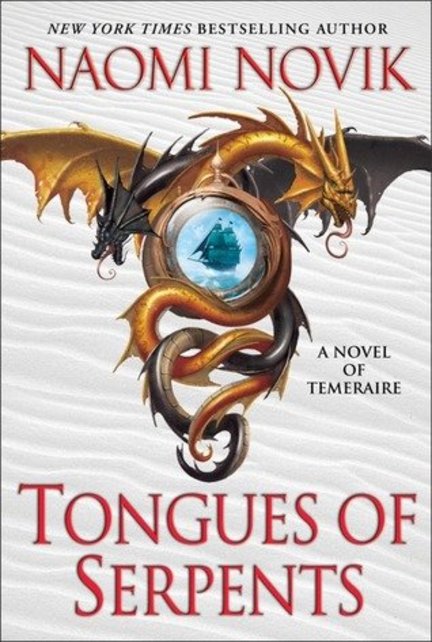
Tongues of Serpents - Naomi Novik
Tongue of Serpents is the sixth book in Naomi Novik's successful Temeraire series. I understand Novik means to write three more, ending the series with the end of the Napoleonic Wars. Novik's mix of dragons and history proved addictive for many readers but I must admit that I felt the series was running out of steam after reading the fifth book, Victory of Eagles. Given my reaction to the last book in the series I wasn't sure if I wanted to read the next novel as well. I did so anyway last week, my to read stack currently consists of a lot of pretty heavy reading and once in a while I am in the mood for something lighter. Unfortunately, this book turned out to be the weakest in the series so far.After Laurence's antics during the French invasion of England, he manages to escape the death penalty for high-treason, more in particular, for delivering the cure to the mysterious disease that struck the British dragons to France thereby prevent more dragons dying of the illness. Instead being hanged, Laurence and Temeraire, carrying three dragon eggs, are sent to the recently founded colony in Australia to start a new covert. Laurence is less than pleased to be so far away from the war against Napoleon and to make matters worse, the colony is not in a particularly good shape.
Rebellion wrecked the colony recently and the governor appointed by the Crown, William Bligh, has been deposed. He refused to return to England however, biding his time on Van Diemen's Land. With the arrival of Laurence and Temeraire, accompanied by a good number of marines, he sees a chance to return to power. Something that will make Laurence's stay in Australia thoroughly unpleasant. Matters become even worse when one of the dragon eggs disappears during a scouting expedition in the Blue Mountains.
Novik did not make things easy on herself, sending her heroes of to the one part of the planet that is furthest away from the action at the time. The colony at Botany Bay was founded in 1788 and some two decades later it is still not much to look at. It is still mostly a penal colony. Novik uses the Rum Rebellion of 1808 as a background for the story. It takes place some time before Laurence arrives in 1809 but because of the long lines of communication word has not reached England yet. I read an account of this event some years back in The Fatal Shore by Robert Hughes. It's an interesting piece of Australian history but it is mostly background for Novik's story and from what I remember of that book, Novik doesn't stay all that close to actual history. The rather superficial treatment the Australian continent and some of the more notable historical characters receive in this novel surprised me a bit. Other parts of the series use much more accurate historical detail.
Most of the novel is actually taken up by Laurence and Temeraire chasing after the stolen dragon egg through the interior of Australia. We pass by Lake Eyre and Ayers Rock, before heading north in the direction of where today the city of Darwin is located. This trip seals Laurence off from events in the wider world even more. One would expect Novik to pay a little more attention to the Aboriginal cultures that Laurence must have undoubtedly passed on this trip but they are mostly absent in the book. To provide some tension in the story Novik introduces a Chinese attempt to set up a trading post in Australia. The geopolitical significance of this move is not lost on Laurence but being the adopted son of the emperor, it does put him in a difficult position.
The whole plot feels very forced, Novik has to introduce some unlikely developments into the story to keep the story arc somewhat interesting. While she succeeds in this to some extend, the overall plot of the series doesn't seem to move forward one bit. When Laurence returns from this inland trip, he is no closer to returning to the struggle with the French than he is at the beginning of the novel. Since Napoleon is unlikely to invade Australia in the next book, Novik still has to come up with something plausible to get Laurence and Temeraire out of there. I wouldn't be surprised if they ended up somewhere in the New World from the hints the author drops but I guess we'll have to read and find out.
Tongue of Serpents is not a long novel but even if we take that into account, Novik achieves very little in that space except expose the reader to yet another hard and long journey. I'm not easily bored when reading, even if the book is not 'fast-paced' by today's standards but I do feel I have just read a whole lot of filler and very little substance. Novik does not even come close to the standard she set in the first novel in this series, His Majesty's Dragon. Given the problems with previous novels I had not really expected a book as good as that but Novik disappointed me nonetheless. It's a lacklustre effort by an author who has shown she can do much better. Hopefully she can recover from this low in the next volume.
Book Details
Title: Tongues of Serpents
Author: Naomi Novik
Publisher: Del Rey
Pages: 274
Year: 2010
Language: English
Format: Hardcover
ISBN: 978-0-345-49689-8
First published: 2010
Saturday, June 26, 2010
Victory of Eagles - Naomi Novik
Victory of Eagles is the fifth instalment in Novik's Temeraire series. I thought the previous four books had ups and downs but in general they are fun, fast reads. The fourth book, Empire of Ivory had a very promising end so I was rather looking forward to reading this. I guess this book mirrors the series as a whole in that it has its ups and downs but is generally enjoyable. It will be the last Novik review for a while. I have caught up with the author. The sixth instalment, Tongues of Serpents, is due next month in hardcover. Although I enjoyed the series I don't think it is quite good enough to invest in one of those. I guess it will be next year before I get around to reading part six.After Laurence's decision to deliver the cure for the dragon disease that struck Britain in Empire of Ivory to the French, thereby undoing a deliberate attempt by the British to infect the French dragons, he is put on trial and condemned to a traitors death. The British are very pragmatic about the matter though. With Napoleon clearly preparing a second attempt at invasion, Temeraire cannot be spared from combat duties. Laurence is put away to ensure his good behaviour. Temeraire spends his time at a breeding ground in Wales waiting for something to happen. The treatment of the dragons there are a constant source of annoyance to him and he tries to convince the dragons they should not accept such treatment. This does not appear to make much of an impact.
The ship Laurence is kept prisoner on happens to be in the wrong spot when the French decide to invade. He gets involved in the battle. When the dust settles and the magnitude of the disaster becomes clear to the British, he is sent to Wales to fetch Temeraire and return to active duty. This turns out to be a bit of a problem. Tired of sitting and waiting while the French invade, Temeraire has decided to take action and leave the breeding grounds. When Laurence arrives and finds him gone a difficult search for Temeraire begins.
By the end of the previous book there has been quite a bit of divergence from history as we know it. There is very little recognizable history left for someone with my limited knowledge. The mental state of King George III is mentioned. The raid on Denmark in 1807, which in Novik's time line is lead by Nelson, also plays a small role in the book by providing an opening for the French to break the naval blockade. The invasion is entirely fictional of course but it is met by one of the most famous historical figures in the book is General Arthur Wellesley, better known as the Duke of Wellington. In our version of history he rose to prominence in the Peninsula War and did not become a Duke until 1814. Novik moves his rise forward a few years. By the end of the last book I had more or less expected Novik to let go of historical events entirely but some links obviously remain.
With all that military action going on in the book and with the main characters right in the middle of it, one would expect this novel to be heavy on battle scenes. And indeed two major battles are described in the book, both of which Temeraire is very much involved in. Between those two events surprising amount of the book is dedicated to logistics and skirmishes. With the inclusion of dragons foraging and logistics differ quite a bit form what an ordinary army would need. Although the way the British finally manage to lure Napoleon into battle at their terms is quite ingenious, the middle part of the book was not all that interesting. My attention flagged on several occasions.
Part of the cause is probably in the very dark mood that permeates the entire novel. Laurence is literally waiting to be hanged so he can be done with it. He is doing his duty as he sees it but he is not happy about his orders and burdened by guilt about the people who have been affected by his treason. In effect it makes him a very passive character for most of the book and at times the do-your-worst-you-can't-kill-me-twice attitude annoyed me tremendously. Temeraire still does not seem to have understood the profound social impact of Laurence's treason. He is quite puzzled as to why Laurence would agree to be hanged in the first place. After four books the gap in understanding between them seems to be widening.
With Laurence not actively interfering for a change, Temeraire is full of initiative. He means to push his dragon emancipation agenda forward full force now that the British need their full support. His manoeuvring is rather clumsy, Temeraire might possess a powerful brain but he is young and inexperienced. Much of his negotiations are nothing short of blackmail. Although I can see why, after putting his ambitions aside for more pressing concerns for so long, Temeraire is eager to proceed but the lack of guidance by Laurence is telling. In previous books, Throne of Jade in particular, the interaction between Laurence and Temeraire is one of the strong points of the book. Laurence's attitude in this book changes that. It's like he is giving up on guiding the dragon altogether. He seems to think it is out of his hand. This air of defeat that can be found in much of the novel didn't suit his character at all.
I must admit the big battle at the end makes up for the part of the book that failed to hold my attention. It's probably the strongest finale Novik has written yet. It's not quite enough to make Victory of Eagles into a good read though. I guess it's a case of too little, too late. I also suspect Novik managed to get herself in trouble for the next book by forcing her characters away from the main action again but we'll see about that when I read Tongues of Serpents. Sticking to this book, I guess you could say it is neither the best nor the worst in the series. It's enjoyable, delivers what the readers have grown to expect but I didn't think it was surprising or outstanding in any way.
Book Details
Title: Victory of Eagles
Author: Naomi Novik
Publisher: Del Rey
Pages: 376
Year: 2009
Language: English
Format: Mass Market Paperback
ISBN: 978-0-345-51225-3
First published: 2008
Wednesday, May 12, 2010
Empire of Ivory - Naomi Novik
Empire of Ivory is the fourth book in Naomi Novik's successful Temeraire series. I read the first three in the last couple of months and found them to be fast, fun reads. The third book, Black Powder War, showed some serious flaws however and I must admit I feared Novik had run out of steam at this point in the series. In Empire of Ivory Novik offers a better story but it's not entirely without its problems either. Nothing that will discourage a fan of this serious though, it is another fast, fun novel with a promise of a quite dramatic book five at the end of it.Captain Will Laurence and Temeraire have finally managed to make their way back to Britain only to find the Aerial Corps in shambles. A disease has struck the dragons, leaving many of them unable to perform their duties. Several dragons have already died and only a handful are still unaffected by the disease. Temeraire and the feral dragons that accompanied him are quickly put on patrol duty to at least keep up the appearance of a stout areal defence. The French have been probing for weaknesses and it is only a matter of time before the state of the British defences become know.
When Temeraire tries to intercept a small French messenger dragon who has seen the quarantined sick dragons he is accidentally exposed to the illness. Surprisingly enough he turns out to be immune and this provides a clue to a possible treatment for the disease. At their stopover in the Cape Colony on their way to China, events depicted in Throne of Jade, Temeraire recovered from the very symptoms that now plague his colleagues. An expedition is mounted to the Cape to find out what element of Temeraire's diet has proven essential to his recovery. The must hurry, time is running out for many of the dragons and Napoleon has clearly not given up on invading England.
What struck me most about this book is the extend to which Novik deviates from history as we know it. Until now she has depicted events more or less as we know them from the history books. Although there are clues throughout the books that the history of the new world in particular has been drastically altered by the presence of dragons, in Europe things seem to be pretty much what we expect. The first thing that struck me is the fact that Nelson survived the Battle of Trafalgar. This may have been mentioned in His Majesty's Dragon in which the battle plays a role. I must admit I can't remember the scene in that much detail. Laurence meets him several times in this book. He's depicted as a not unpleasant but rather vain man.
The history of the Cape Colony is also very drastically altered in the book. The region changed hands a couple of times during the French Revolutionary and Napoleonic wars before becoming permanently British in 1806 (until it became South Africa in 1910). When Laurence and Temeraire arrive in 1807 the provisional governor Henry George Grey is still at the helm. Events triggered by Laurence and Temeraire moving into Africa's interior, they travel as far as the Victoria Falls, which had not been named such of course, Victoria would be born in 1819, and find an Africa affected by Slave trade and the coastal settlements of various European countries but still firmly independent. I'm not going to say too much about it to avoid spoilers but it looks like dragons are going to severely impact the colonization of Africa.
Temeraire's ambitions to improve conditions for dragons in Britain is mostly pushed to the background. Although Novik devotes some attention to the parallel abolitionist movement, demands of the moment push it mostly into the background. A bit of a shame since Temeraire's plans could have made for some interesting political struggles. In fact, the last books seemed to promise some more action this point and I was a bit disappointed to see it downplayed in favour of exploring the more exotic parts of the African interior. Given the ending of Empire of Ivory it doesn't look like Temeraire will make much progress in the next book, Victory of Eagles, either. That sense of adventure is one of the more attractive parts of the series however, so perhaps it shouldn't have surprised me.
In the end Empire of Ivory offers a better structured and more complete story arc of its own, centred on the mysterious disease, than the previous book. I have seem some complaints in other reviews that the novel takes its time to get going but that is certainly not my experience. It does take a little time get reacquainted with the situation in England, which after an absence of a year can hardly be a surprise. It does end in a major cliffhanger however. If you don't like that in a book then this one might be a bit annoying for you. I think the ending does offer some interesting action in book five but on the other hand some of the heavier themes in the books are not quite given the attention they deserve and the series remains rather light because of that. Still, it is good to see Novik improve on the rather poor Black Powder War, it will be interesting to see if she can keep the momentum going in Victory of Eagles.
Book Details
Title: Empire of Ivory
Author: Naomi Novik
Publisher: Del Rey
Pages: 404
Year: 2007
Language: English
Format: Mass Market Paperback
ISBN: 978-0-345-49687-4
First published: 2007
Tuesday, March 9, 2010
Black Powder War - Naomi Novik
With Black Powder War Novik finishes the first arc in her successful Temeraire series. The first two books in the series were surprisingly entertaining. I generally prefer my dragon in small doses so I read books including this fantasy trope only once in a while. Both His Majesty's Dragon and Throne of Jade were good, if not flawless, reads in their own way. I enjoyed Black Powder War as well but I am beginning to fear this series won't keep me interested much longer. Laurence and Temeraire have a fine adventure but this book is very much a middle book.After surviving a fierce round of Chinese court intrigue and ending up as adopted Chinese royalty, it is time for Temeraire and Laurence to consider their return trip to England. A trip that becomes all the more urgent when orders arrive asking Laurence to travel to Istanbul where the British have bought three valuable dragon eggs for a considerable sum of money. The eggs are to be transported to England before they hatch. Before they can begin their trip from Macao to Istanbul however, disaster strikes their transport and a large fire breaks out on board. The ship can be saved but needs extensive repairs. This delay is simply not acceptable. Laurence and Temeraire opt for the dangerous journey overland.
After a long and dangerous journey Laurence finds Istanbul not quite what he hoped for. The British ambassador seems to have perished in an accident and the Sultan insists he has not received the payment. The money is missing and to make matters worse, Lien, one of the Chinese dragons involved in a recent attempt to replace the emperor and a bitter enemy of Temeraire, has made an appearance. Somehow Laurence must manage to acquire the eggs and handle an ever impatient dragon, intend on returning to England and applying some of the things he has learnt in China to improve the living conditions for British dragons. Their journey is far from over. It seems the road back to Dover is long and winding indeed.
Novik's novels are perhaps more historical than fantasy and this a large part of this novel is devoted to the battle of Jena-Auerstedt, fought in October 1806, where, how can I put this gently, the Prussians got their ass handed to them by the French, removing Prussia from the War of the Fourth coalition. Dragons, unfortunately for the Prussians, did not change that outcome one bit it appears. Novik's descriptions of the battle and the entire campaign are vivid and one can't help but feel sympathy for Temeraire and her crew, being caught up in a major defeat of one of their allies without being able to alter the outcome at all. Oddly enough there is no mention of this event in the cover text, leading me to believe the important events in this book would be set in the Ottoman Empire.
A lot of this book is about getting Temeraire and his crew from one part of the world to another, which is what a lot of Throne of Jade was dedicated to al well. I don't feel Novik manages to use the time in transit to develop her characters quite as effectively as in the second book. The battle in Germany felt like a detour to me. It shows us a nice piece of history, the author uses it to some extend as a learning experience to the still very naive dragon, but other than that it does not seem to be all that necessary for the plot. The storyline concerning the eggs Laurence is sent to Istanbul for, seems to more or less put on hold while they fight the battle. Quite odd since, again, the significance of these dragon eggs to the overall story is not clear.
It's not all bad though. Temeraire's naivete is still endearing, as are Laurence's attempts to shield him for what he feels must be certain disappointment when finding out England will not be all that interested in improving conditions for its dragons are comical at times. The emancipation of dragons theme is something which I had expected to be more prominent in this book but when it does come up, Novik offers an interesting parallel with the abolition of slavery by the Brittish, a hotly debated issue at the time. There seems to be enough opportunity to add a little depth to the plot but alas, it is not happening in this book. The ending, and I'll try not to spoil it for you, is quite abrupt and not very uplifting. In a way Laurence and Temeraire can claim victory but one obviously overshadowed but the catastrophe that is the war in Prussia. The book also ends rather abruptly. It would have been nice to have gotten a glance at England before the end of the book but Novik saves that for the fourth book in the series, Empire of Ivory.
Black Powder War is an entertaining read and those who enjoyed the first two books will want to read it. It falls short of the standard set in the first two novels though. I found the meandering plot to be the largest problem. Mostly the novel is one big bridge from resolving Temeraire's problems in China to getting back to England with very little else added to the story. It sets a brisk pace and I very much appreciated the historical part of the novel but that does not make up for it's flaws. I'm hoping for better things in the next book. If not, this series is in trouble.
Book Details
Title: Black Powder War
Author: Naomi Novik
Publisher: Del Rey
Pages: 365
Year: 2006
Language: English
Format: Mass Market Paperback
ISBN: 978-0-345-48130-6
First published: 2006
Wednesday, January 27, 2010
Throne of Jade - Naomi Novik
I picked up my girlfriend's copy of His Majesty's Dragon a while ago when my stack of to read fantasy novels had reached a low and I was pleasantly surprised by it. I'm still not sure if I will stay on board for the whole series, I understand Novik means to write nine books in total, but the second book in the Temeraire series was definitely on my to read list. Although the story picks up where His Majesty's Dragon ended, in many respects Throne of Jade is quite a different book. Novik manages to surprise me a second time.With the battle of Trafalgar won and the French areal invasion fleet defeated things calm down slightly for Laurence and Temeraire. Until the Chinese show up that is. Their prized Celestial was a gift to the French Emperor Napoleon and they refuse to accept he is now used to fight England's battles. An unworthy activity for such a fine specimen, he must return to China. Laurence finds himself separated from Temeraire and withdrawn from patrol duties. An meeting with the Chinese diplomats turns into a disaster and after a blatant attempt to separate the two permanently Temeraire makes his opinion know by flying away with Laurence to join their fellows in a battle over the Channel.
Since Laurence and Temeraire cannot be parted it and the Chinese refuse to abandon him to the British the only possible compromise seems to be for Laurence to accompany Temeraire on the long journey. Preparations by the nearly desperate British officials are made swiftly and soon the Chinese delegation as well as Laurence and Temeraire are on a dragon transport ship on the high seas. Their journey will take many months and there will certainly be some surprises waiting for them at the end of it.
Throne of Jade starts off familiar enough with some heated discussion by Laurence over Temeraire's treatment as well as a spectacular areal battle in the opening stages of the novel. The character of the novel soon changes though. A large part of the tale is dedicated to the trip to China, which in 1806 could take more than half a year. With little to do on board there is plenty of time for introspection and Laurence does his share of that. The Chinese are obviously trying to get into Temeraire's good graces and pry him away from the barbarians why currently hold his affection. Laurence is not quite sure how to deal with that.
On the other hand he is curious too. Chinamen in the west was far from a common occurrence in those days. They know almost nothing of each other's habits, customs and society. Despite the formidable language barrier, Novik seems to have a more realistic idea on how fast a human can learn a language completely unrelated to their own, progress is being made. These clashes between the their cultures are very well done. I rather enjoyed this part of the book. If you liked the previous book for the relentless pace Novik sets it is going to be a bit of a disappointment but I thought it was one of the better parts of the novel. Laurence and Temeraire grow more on that journey than in the rest of the first two books combined.
As much as I have enjoyed it, the extended journey does not leave all that much of the book to be spent in China. It makes the book as a whole a bit unbalanced. Novik avoids a lot of the Chinese court politics by keeping Laurence and Temeraire locked up in their pavilion for most of their time there. The accommodation reached at the end of the book has very little to do with Laurence himself and a lot of the intrigue goes right over his head. Novik clearly introduces the themes for the next book in the second half of Throne of Jade, one which could potentially be very interesting. With all this growing up the characters do and all the preparing the reader for the next book, Throne of Jade clearly exhibits the symptoms of the middle book syndrome and I don't think that was quite necessary.
Another difference with His Majesty's Dragonn is that we're much less reminded of the historical context of the book. Napoleon is a distant threat for most of it. There are references to the Battle of Austerlitz and the end of the Third Coalition, usually considered one of his biggest victories and to the (second) British takeover of the Dutch Cape Colony but nothing that really touches the story directly. I also get the impression that China is presented as a stronger state than it was at the time, the first cracks in the rule of the Qing dynasty had already appeared by then. There are some hints as to what is going on in the Chinese empire at the time but I would not have minded a bit more detail in this respect.
I enjoyed Throne of Jade just as much as His Majesty's Dragon but for quite different reasons. Both have their flaws but more than enough good points for the balance to be positive. I guess Throne of Jade is a bit harder to like, with little of the book focussed on battles and aerial acrobatics but that is hardly something the author can be expected to keep up for nine books. Perhaps Novik has not quite found the right balance between action and developing her characters and the relationships between them. Something I hope Novik can improve on in the third book Black Powder War. I guess I am on board for one more at least.
Book Details
Title: Throne of Jade
Author: Naomi Novik
Publisher: Del Rey
Pages: 399
Year: 2006
Language: English
Format: Mass Market Paperback
ISBN: 978-0-345-48129-0
First published: 2006
Tuesday, December 15, 2009
His Majesty's Dragon - Naomi Novik
Dragons are a fantasy cliché I am not particularly fond of. Not that it cannot be used to great effect but I rarely encounter books where the author gets the best out of the cliché and manages to do more with dragons than emphasizing the fantasy setting. My girlfriend on the other hand loves fantasy tales with dragons in them. There's a whole stack of McCaffrey's Pern books right behind me on a the cupboard (shelf space is a bit of a rare commodity in this house, or maybe we just own too many book). It is not altogether surprising she picked up this series a while ago and loved them. Since my to read pile mostly consists of science fiction at the moment and I was not in the mood for one of those, I picked up Novik's first Temeraire novel. His Majesty's Dragon proved to be a fun read.The year is 1805. After defeating the armies of the second coalition France, now fully under the control of Napoleon Bonaparte seems to be firmly in control on the continent. He has cast his eye on the one enemy remaining undefeated, the British Empire. The British suspect Napoleon has plans for an invasion of Britain and are gathering a new coalition against him. If any attempt of an invasion are to be successful Napoleon will have to deal with the British fleet however and it is men such as Captain Will Laurence's job to prevent the French from dominating the seas.
Under his command the HSM Reliant captures a French frigate. Given the condition of the ship this is not much of an achievement but the cargo it turns out to be carrying makes it worth the effort. The British have captured a dragon egg that is about to hatch. It puts Laurence in a difficult position. When the dragon hatches it needs to be harnessed right away for it to be useful in aerial combat. Harnessing the dragon means a life dedicated to the aerial corps, making the captain of the dragon a social outcast. Laurence must sacrifice one of his crew to attempt to harness the dragon and he can't very well demand a sacrifice of his men he is not willing to make himself. His life is about to be turned upside down.
For the most part His Majesty's Dragon is a historical novel, the dragons play an important role in the story but they are the only fantasy element Novik has added. Appart from the dragons Novik follows the course of history as we know it. As such, the end of the novel does not come as a great surprise but I can't say that bothered me much. In Laurence Novik creates a very believable early 19th century British captain. His belief in the strength of his nation and its political system are unshakeable. Although he does appreciate Napoleon's achievements on the continent in a way he still thinks him a tyrant. Something that in the light of what we now consider political freedom is quite amusing at times.
The Dragon, and I suppose given my views on this particular fantasy concept this should not come as a surprise, is slightly more problematic. One of the minor characters in the book tries to approach the subject in a scientific fashion. Suspension of disbelief most certainly was not enough to not laugh out loud at that. There's all manner of other impossibilities as well. England has quite a few dragons, France even more. The economics of keeping them fed in a time when livestock was quite valuable is beyond me. A large dragon can eat several cows a day apparently. Temeraire is also unreasonably gifted at languages.
Things like this would bother me in most novels but I must admit the combination of Temeraire's great intelligence and his naïveté is endearing. Given his background it is unavoidable that Laurence has different ideas on his new duty than most of the aviators raised to the aerial corps. It influences Temeraire's personality to a point and shapes the relationship between the dragon and his captain but it also has repercussions for the aerial corps. His Majesty's Dragon is a short and rather fast paced novel so there is not that much space to explore this. I expect it will be a theme in following books in the series.
His Majesty's Dragon is not the best fantasy novel I have read but it is a fast and fun read. It's one of those books you can easily read in a day. I was pleasantly surprised by how much liked this book. It combines a fascinating bit of history with a popular fantasy trope and the result is certainly worth reading. I'm pretty sure I will end up reading the second book sometime soon. Maybe my girlfriend's taste in books overlaps with mine to a greater extend than I thought. I will not read any more Pern novels though!
Book Details
Title: His Majesty's Dragon
Author: Naomi Novik
Publisher: Del Rey
Pages: 356
Year: 2006
Language: English
Format: Mass Market Paperback
ISBN: 0-345-48128-3
First published: 2006
Subscribe to:
Posts (Atom)